
6
Introduction: Why Are Property Prices Rising So Fast?
Over the last few years, Indians have witnessed a sharp increase in the prices of:
- Residential apartments
- Independent houses
- Commercial SCOs
- Office spaces
- Industrial plots
- Retail shops
- Land parcels
Many people assume builders are simply increasing prices to earn higher profits.
The reality is more complicated.
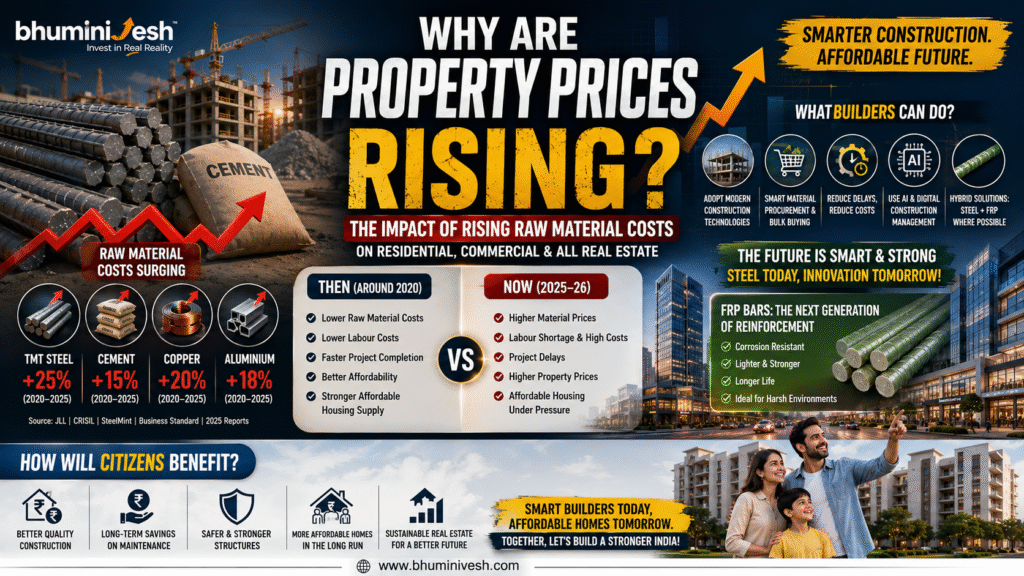
A major reason behind rising property prices is the significant increase in construction costs, labour expenses, land acquisition costs, infrastructure charges, financing costs, and compliance expenses. Industry reports indicate construction costs in India are expected to rise by approximately 3–5% in 2026, with labour costs increasing even faster in many regions.
For citizens, the biggest question is:
Can real estate become affordable again?
Let’s examine the facts.
The Cost of Building a Property Has Changed Dramatically
Five Years Ago vs Today
Construction today costs substantially more than it did before the pandemic.
Industry analyses show:
- Construction costs have increased significantly over the last five years.
- Affordable housing margins have been squeezed because of rising material and labour expenses.
- Raw material costs such as steel, copper and other inputs have risen sharply over the longer term.
Why It Matters
When the cost of building increases, developers have only three options:
- Absorb losses.
- Reduce quality.
- Increase selling prices.
Most choose the third option.
How Much Does Steel Influence Property Prices?

Steel is often called the skeleton of a building.
For:
- High-rise towers
- Commercial complexes
- SCO projects
- Industrial buildings
- Villas
Steel reinforcement is one of the largest cost components.
According to World Steel Association forecasts, steel demand in India is expected to grow around 9% annually, reflecting strong infrastructure and real estate demand.
As demand rises:
- Steel manufacturers face capacity pressures.
- Transportation costs increase.
- Builders experience greater cost volatility.
Every increase in steel prices eventually affects property pricing.
Cement, Copper, Aluminium & Other Materials Are Also Becoming Costlier
Many people focus only on steel.
But modern construction depends upon:
- Cement
- Aluminium
- Copper
- Electrical systems
- Plumbing systems
- Glass
- Tiles
- Paint
- Waterproofing chemicals
Recent industry reports indicate copper and aluminium costs have experienced notable increases, creating additional pressure on developers.
This means:
Even if steel stabilizes, property prices may continue rising because multiple materials are becoming more expensive simultaneously.
Labour Costs: The Hidden Price Explosion

The biggest surprise for many developers has been labour costs.
Industry estimates suggest labour expenses have increased significantly over recent years, while skilled labour shortages remain a challenge.
Reasons include:
- Migration patterns after COVID
- Higher living expenses
- Demand for skilled workers
- Infrastructure projects competing for manpower
As labour becomes expensive:
- Construction timelines increase.
- Project costs increase.
- Final property prices increase.
Why Commercial Properties Are Becoming Even More Expensive
Commercial projects consume more:
- Steel
- Glass
- HVAC systems
- Elevators
- Fire systems
- Power infrastructure
Modern commercial buildings require significantly more engineering than residential projects.
This is one reason many new SCO and retail projects are launching at prices far higher than similar projects from five years ago.
Is There a Better Alternative to Traditional Steel?
This is where a major industry debate has started.
Can Fiber Reinforced Polymer (FRP) Bars Replace Steel?

FRP (Fiber Reinforced Polymer) bars are gaining attention globally.
Advantages include:
- Corrosion resistance
- Lower weight
- High strength-to-weight ratio
- Reduced transportation costs
- Longer service life in harsh environments
Some manufacturers claim FRP rebars can be significantly lighter than steel while offering strong performance in specific applications.
Should Builders Completely Replace Steel with FRP?
The short answer:
No—not yet.
Why?
Steel still offers advantages:
- Proven performance
- Widespread availability
- Lower upfront cost
- Better familiarity among engineers
- Strong seismic behavior characteristics
FRP currently works best for:
- Coastal projects
- Bridges
- Industrial structures
- Corrosion-prone environments
- Specialized infrastructure projects
For ordinary residential towers in cities like Chandigarh, Mohali, Panchkula, Delhi, Mumbai, and Bengaluru, complete replacement of steel is still uncommon.
The Real Problem: FRP Is Not Always Cheaper
Many people assume new technology automatically reduces costs.
Not necessarily.
Several industry analyses show FRP reinforcement generally costs more initially than traditional steel reinforcement.
However:
Lifecycle Cost vs Initial Cost
Steel:
- Lower purchase price
- Higher maintenance over decades
FRP:
- Higher purchase price
- Lower maintenance
- Longer durability in specific conditions
This means FRP may make sense for long-life infrastructure but may not immediately reduce apartment prices.
What Can Builders Do to Reduce Construction Costs?
Instead of relying on one miracle material, builders need a combination strategy.
1. Adopt Modern Construction Technologies
Examples:
- Precast construction
- Modular construction
- Aluminum formwork systems
These reduce:
- Labour dependency
- Construction time
- Material wastage
2. Improve Material Procurement
Large developers can:
- Buy steel in bulk
- Negotiate long-term contracts
- Reduce market volatility exposure
3. Reduce Project Delays
Every delay increases:
- Interest cost
- Labour cost
- Material cost
Fast completion reduces overall project cost.
4. Use Hybrid Reinforcement Systems
Instead of replacing steel completely:
Builders can use:
- Steel in critical zones
- FRP in corrosion-prone areas
This can improve efficiency without drastically increasing costs.
5. Adopt AI & Digital Construction Management
Modern project management can reduce:
- Material theft
- Over-ordering
- Scheduling inefficiencies
Result:
Lower project costs.
What Should Government Do?
The government also has an important role.
Simplify Approval Processes
Many projects spend years waiting for approvals.
Time equals money.
Faster approvals reduce carrying costs.
Improve Infrastructure
Better roads and logistics reduce:
- Transportation costs
- Material costs
- Delivery delays
Promote Affordable Housing
Construction cost increases have already hurt affordable housing supply. Reports indicate affordable housing’s share of launches has fallen significantly while luxury housing continues growing.
Targeted incentives could help revive affordable development.
How Does This Affect Citizens?

Citizens are experiencing:
Higher Purchase Prices
Every increase in construction cost eventually reaches buyers.
Higher Rents
Reuters surveys indicate rents are also expected to rise, putting pressure on families who cannot immediately purchase homes.
Smaller Homes
To maintain affordability:
Developers often reduce unit sizes.
Shift Toward Outskirts
Many buyers are moving toward peripheral locations where land remains cheaper.
Comparing Property Prices: Then vs Now
| Factor | Around 2020 | 2025-26 Situation |
|---|---|---|
| Steel Demand | Moderate | Strong growth |
| Labour Cost | Lower | Significantly higher |
| Construction Cost | Lower | 3–5% annual pressure |
| Affordable Housing Supply | Stronger | Reduced share |
| Luxury Housing | Smaller segment | Growing rapidly |
| Property Prices | Moderate growth | Faster appreciation |
Sources indicate housing prices across major Indian cities continue to rise, driven by demand, infrastructure improvements, and higher development costs.
The Future of Real Estate Construction
The future will likely involve:
- Smart materials
- Automation
- AI-driven project management
- Selective use of FRP and composites
- Sustainable construction techniques
The global FRP market itself is expected to grow strongly through 2030, indicating increasing adoption worldwide.
However, steel is unlikely to disappear anytime soon.
Instead:
The industry will move toward a hybrid model where both traditional and advanced materials coexist.
Conclusion: Can Property Prices Come Down Again?
The honest answer is:
A major reduction in property prices is unlikely unless construction costs, land costs, and financing costs fall simultaneously.
What is more realistic is:
- Slower price growth
- Better construction technologies
- More efficient project execution
- Smarter material usage
For builders, the challenge is maintaining affordability while preserving quality.
For citizens, the key is buying projects from financially strong developers who can deliver on time and avoid unnecessary delays.
Final Thought for Bhuminivesh Readers
The future of Indian real estate will not be determined only by land prices.
It will be determined by:
- Technology
- Construction innovation
- Material efficiency
- Responsible development
The builders who adopt these changes first will build faster, cheaper, and more sustainably—and the ultimate beneficiary will be the Indian homebuyer. 📈🏠
Suggested Blog Title Banner:
“Why Are Property Prices Rising? The Hidden Impact of Steel, Cement & Construction Costs on India’s Real Estate Market”
