
The Airport Effect: How New Airports Create Crorepati Landowners in India
Introduction: When Runways Create Wealth
Throughout history, major infrastructure projects have transformed local economies. Railways created industrial cities. Highways generated logistics hubs. Metro networks increased property values across urban corridors.
Today, airports are emerging as one of the most powerful drivers of real estate appreciation in India.
Whenever a new international airport is announced, the first headlines focus on aviation, tourism, and connectivity. However, the biggest financial impact often occurs long before the first flight takes off.
It happens on the ground.
Thousands of acres of land are acquired. Farmers receive compensation. Roads are widened. Industrial zones emerge. Warehousing parks are established. Hotels, commercial projects, housing societies, logistics hubs, and business parks begin appearing around the airport.
In many cases, landowners who once cultivated agricultural land suddenly become crorepatis.
This phenomenon is known as the “Airport Effect.”
From Jewar in Uttar Pradesh to Navi Mumbai in Maharashtra and Parandur in Tamil Nadu, airport-led development is reshaping India’s real estate landscape.
The question investors should ask is simple:
Can airports create wealth before the planes arrive?
The answer is increasingly becoming yes.
What Is the Airport Effect?
The Airport Effect refers to the economic and real estate transformation that occurs around a new airport.
Modern airports are no longer just transportation facilities.
They function as economic ecosystems that attract:
• Logistics companies
• Warehousing operators
• Hotels
• Business parks
• IT companies
• Retail centers
• Residential developments
• Manufacturing units
The airport becomes the anchor around which entire cities can grow.
Globally, cities such as Dubai, Singapore, Amsterdam, and Seoul have demonstrated how airport-driven development can generate billions of dollars in economic activity.
India is now witnessing the same trend.
Why Airports Increase Land Prices
1. Connectivity Creates Demand
Businesses prefer locations with better national and international connectivity.
As airports improve access to markets, land demand increases.
A location that was once considered remote suddenly becomes strategically important.
2. Infrastructure Follows Airports
Governments rarely build airports in isolation.
Airport projects are typically accompanied by:
• Expressways
• Metro connectivity
• New roads
• Utility upgrades
• Industrial corridors
Infrastructure investment itself pushes property prices upward.
3. Employment Generation
Airports generate direct and indirect jobs.
Airlines, cargo operators, ground handling agencies, hotels, restaurants, security firms, transportation providers, and retail businesses all require manpower.
As employment rises, housing demand increases.
4. Commercial Development
Office parks, convention centers, logistics facilities, and commercial districts often emerge near airports.
Commercial demand further increases land values.
The Jewar Airport Story: India’s Largest Airport-Led Transformation
Perhaps no project demonstrates the Airport Effect better than the Noida International Airport at Jewar.
The airport has become one of India’s most ambitious infrastructure projects.
The development is expected to transform the Yamuna Expressway region into a major economic hub. The airport is projected to improve connectivity and accelerate industrialization across western Uttar Pradesh.
When land acquisition began, large portions of the surrounding area consisted of agricultural land.
Today, investors, developers, industrial players, and logistics companies are actively targeting the region.
How Much Compensation Did Farmers Receive?
One of the most discussed aspects of the Jewar Airport project is compensation.
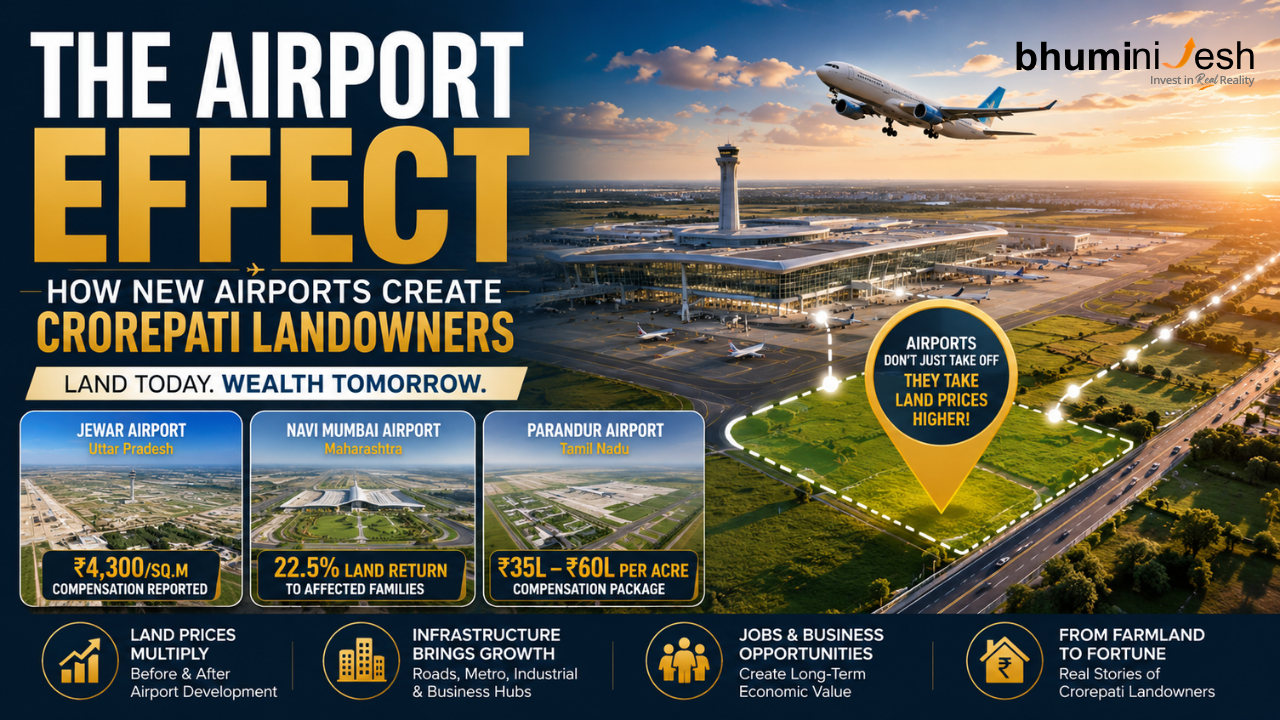
For later acquisition phases, compensation rates reached approximately ₹4,300 per square metre, significantly higher than earlier acquisition rates.
Considering that many landowners held multiple bighas or several acres, compensation amounts often reached crores of rupees.
Reports indicate that numerous families received multi-crore payouts following land acquisition for airport development.
For many farming households, this represented the largest financial event in their family’s history.
Beyond Compensation: What Else Did Families Receive?
Most people believe airport land acquisition only involves monetary compensation.
In reality, modern rehabilitation policies frequently include additional benefits.
Rehabilitation and Resettlement
Authorities have implemented rehabilitation plans for thousands of affected families around airport projects. In Jewar’s expansion phases, rehabilitation arrangements were planned for approximately 16,000 affected farming families.
Developed Residential Plots
In some airport projects, affected families receive developed plots in resettlement areas.
This ensures families retain long-term assets rather than relying solely on cash compensation.
Infrastructure and Community Facilities
Resettlement colonies often include:
• Roads
• Electricity
• Water supply
• Schools
• Healthcare facilities
Though implementation quality varies by project, rehabilitation is intended to provide sustainable relocation opportunities.
Employment Opportunities
Project-affected communities frequently seek job opportunities linked to airport development.
Employment for affected families remains a major demand across several airport projects in India.
Navi Mumbai Airport: A Different Compensation Model
The Navi Mumbai International Airport offers one of India’s most interesting rehabilitation models.
Instead of relying only on cash compensation, the project incorporated a land-return mechanism.
Under CIDCO’s rehabilitation framework, eligible project-affected persons were offered developed land equivalent to 22.5% of their acquired agricultural land.
This approach is unique because:
A farmer may lose agricultural land but receive a smaller parcel of developed urban land.
Over time, developed urban land can appreciate substantially more than agricultural land.
Many urban planners consider this one of India’s most innovative rehabilitation approaches.
Additional rehabilitation measures included resettlement plots and allocation schemes for affected families.
Can Compensation Alone Create Long-Term Wealth?
The answer is complicated.
Many airport-affected families became crorepatis overnight.
However, long-term wealth creation depends on financial planning.
Some families invested compensation wisely into:
• Commercial property
• Residential real estate
• Rental assets
• Businesses
• Education
Others exhausted compensation through lifestyle spending.
This highlights an important lesson:
Compensation creates opportunity.
Investment decisions determine whether wealth survives across generations.
The Rise of Airport Cities
Globally, the concept of “Aerotropolis” or Airport City is becoming increasingly popular.
An Aerotropolis is an urban area built around an airport.
Instead of the airport serving the city, the city grows around the airport.
Common components include:
• Business districts
• Logistics parks
• Hotels
• Convention centers
• Warehousing hubs
• Residential townships
This model is increasingly influencing Indian infrastructure planning.
Real Estate Winners Around Airports
Industrial Land
Industrial land often benefits first.
Logistics operators require large parcels close to airports.
Warehousing
E-commerce growth is increasing demand for airport-linked warehousing.
Fast delivery networks rely heavily on air cargo infrastructure.
Hospitality
Hotels, serviced apartments, and convention centers emerge around airports.
Residential Property
Airport-driven employment creates housing demand.
Apartments, plotted developments, and integrated townships frequently follow.
Upcoming Airport Projects Investors Should Watch
Noida International Airport (Jewar)
Potential impact zones:
• Yamuna Expressway
• Greater Noida
• Jewar
• Tappal region
Navi Mumbai International Airport
Potential impact zones:
• Panvel
• Ulwe
• Pushpak Nagar
• Uran
Parandur Airport (Tamil Nadu)
The proposed airport project includes compensation packages ranging from approximately ₹35 lakh to ₹60 lakh per acre in many areas, with additional rehabilitation options such as housing, employment support, or cash-based alternatives.
Lessons for Investors
The Airport Effect teaches three important lessons:
Lesson 1: Infrastructure Creates Wealth
Major infrastructure projects often generate property appreciation before completion.
Lesson 2: Follow Government Investment
When governments invest thousands of crores in infrastructure, surrounding land frequently benefits.
Lesson 3: Buy Before Development Peaks
The largest gains are usually made before infrastructure becomes fully operational.
Once airports begin operations, a significant portion of appreciation may already be reflected in prices.
Risks Investors Must Understand
Not every airport project guarantees profits.
Investors should evaluate:
• Regulatory approvals
• Environmental clearances
• Development timelines
• Infrastructure commitments
• Market demand
Delays can affect investment returns.
Conclusion: The Runway to Wealth
The Airport Effect is one of the strongest examples of how infrastructure transforms real estate markets.
A new airport is far more than a transportation project.
It is a catalyst for:
• Economic development
• Employment generation
• Urbanization
• Industrial growth
• Real estate appreciation
The stories emerging from Jewar, Navi Mumbai, and Parandur demonstrate that airport-led development can create substantial wealth for landowners and investors alike.
However, the greatest opportunities often arise before the airport becomes operational.
By the time the first aircraft lands, smart investors have usually already identified the opportunity.
The runway does not merely launch airplanes.
It often launches entire regions into a new era of prosperity.
