
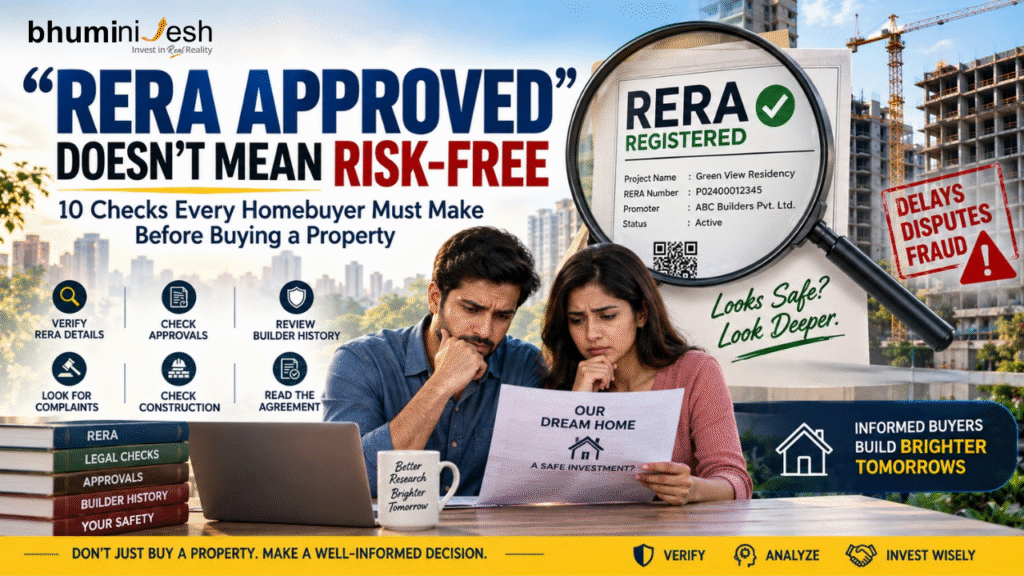
A RERA registration is an important layer of protection—but it is not a government guarantee that a project will never face delay, dispute, misrepresentation, regulatory action or failure.
For millions of Indians, buying a home is the biggest financial decision of their lives. A buyer may spend years saving for a down payment, take a 15- or 20-year home loan and commit a substantial portion of their income to one property.
That is why the words “RERA Approved” have become so reassuring.
A buyer sees a RERA registration number on a brochure, website or sales presentation and may assume that the project has effectively been certified by the government as safe.
But there is an important distinction that every homebuyer should understand:

RERA registration is regulatory protection—not an investment guarantee.
The Real Estate (Regulation and Development) Act, 2016 was created to increase transparency, accountability and consumer protection in India’s real estate sector. It requires covered projects to be registered before advertising, marketing, booking or selling, and creates regulatory and dispute-resolution mechanisms for buyers. (India Code)
Yet recent RERA cases demonstrate that even registered projects can encounter serious problems.
So, before transferring your life savings to a developer, the question shouldn’t simply be:
“Is this project RERA registered?”
It should be:
“What does the RERA record actually tell me about this project?”
What Does “RERA Registered” Actually Mean?
RERA was enacted to bring greater transparency to India’s real estate sector.
Under Section 3 of the Act, covered real estate projects generally require registration with the relevant Real Estate Regulatory Authority before they can be advertised, marketed, booked or sold.
The Act also provides for disclosure of important project information, promoter obligations, financial discipline and remedies for allottees. The Ministry of Housing and Urban Affairs says RERA requires promoters to disclose necessary project details and approvals and to deposit 70% of amounts realised from homebuyers into a separate bank account for land and construction costs. (Press Information Bureau)
That is significant protection.
But registration should not be interpreted as:
“The government guarantees this project.”
The government does not become the developer, contractor, title insurer or financial guarantor of the project merely because it is registered.
The official India Code record shows that RERA itself contains provisions for grant, extension and revocation of registration, along with promoter obligations, advertisement requirements, return of money and compensation. (India Code)
That distinction is the foundation of this entire discussion.
Can a RERA-Registered Project Still Go Wrong?
Yes.
And there are recent examples.
In September 2026, a Haryana RERA case involved a Gurugram homebuyer who had paid approximately ₹14.5 lakh toward a housing project. According to the reported case, construction stalled, the developer’s registration was revoked and the buyer sought a refund. Haryana RERA ordered the developer to refund the amount with 10.80% annual interest. (mint)
The important lesson isn’t that RERA failed.
Quite the opposite.
The case demonstrates that RERA can provide a legal route for a buyer when a project encounters serious problems—but the buyer may still have to go through a dispute-resolution process to recover the money.
For someone who has invested ₹10 lakh, ₹50 lakh or ₹1 crore, that distinction matters enormously.
Case Study: A RERA Number Was Being Used With Another Project Name
One of the clearest warnings comes from Telangana.
In a Telangana RERA proceeding, the authority found that a project registered under one name was being promoted using another name. The authority observed that using the same RERA registration number alongside a different project name could create ambiguity and potentially mislead prospective purchasers. It directed the parties to stop advertising the project under a name different from its registered name. (Telangana RERA)
This creates a very important lesson for buyers:
Never verify only the RERA number.
Verify the combination of:
RERA number + project name + promoter + location + survey numbers + phase + sanctioned plans.
All of them should make sense together.
A salesperson showing you a RERA number is not enough.
You should independently open the official RERA portal and verify the project.
Case Study: A Registered Project Can Also Face Regulatory Changes
Another recent Haryana RERA proceeding illustrates why buyers should monitor a project’s status even after registration.
In August 2026, Haryana RERA dealt with a project whose promoter sought to surrender its registration and proposed changing the nature of the development from a group housing project to an affordable group housing project. The authority noted that the proposed change was subject to approval from the competent authority and that the project would need the requisite statutory approvals before proceeding in the proposed form. (Haryana RERA)
This doesn’t mean the project was fraudulent.
It demonstrates something more subtle:
A RERA registration represents the project’s regulatory status at a particular point in time.
That status can change.
Therefore, checking the RERA portal once at the time of booking may not be sufficient for a project that is under construction for several years.
The 10 Checks Every Homebuyer Should Make
1. Verify the RERA Number Yourself
Never rely solely on the RERA number printed on:
- Brochures
- WhatsApp messages
- Property portals
- Hoardings
- Sales presentations
Go to the official RERA website of the state or UT where the property is located.
Search for the project yourself.
The Ministry’s framework is designed to make project information available for buyers’ due diligence. (Press Information Bureau)
2. Match the Exact Project Name
This sounds simple, but it can be extremely important.
Check whether the name shown by the salesperson exactly corresponds with the name registered with RERA.
Also check whether it is:
- Phase 1
- Phase 2
- Tower-specific registration
- A separate plotted development
- A larger township containing multiple projects
A developer may have several projects with similar branding.
Never assume one RERA registration covers an entire township.
3. Verify the Promoter’s Legal Entity
One of the biggest mistakes buyers make is looking only at the developer’s brand name.
The actual legal promoter could be a:
- Private limited company
- LLP
- Partnership
- Special-purpose entity
- Joint venture
Check the legal entity appearing on the RERA registration and compare it with the entity in your booking and agreement documents.
A famous brand name does not automatically mean every project carrying that brand is owned by the same legal entity.
4. Check the Land and Project Details
A RERA search should not end with the words “Registration Granted.”
Look at the actual project information.
Check:
- Land details
- Survey numbers
- Location
- Promoter details
- Development area
- Number of buildings
- Number of units
- Project phase
- Proposed completion date
The objective is to confirm that the property being sold to you is actually the property registered with the authority.
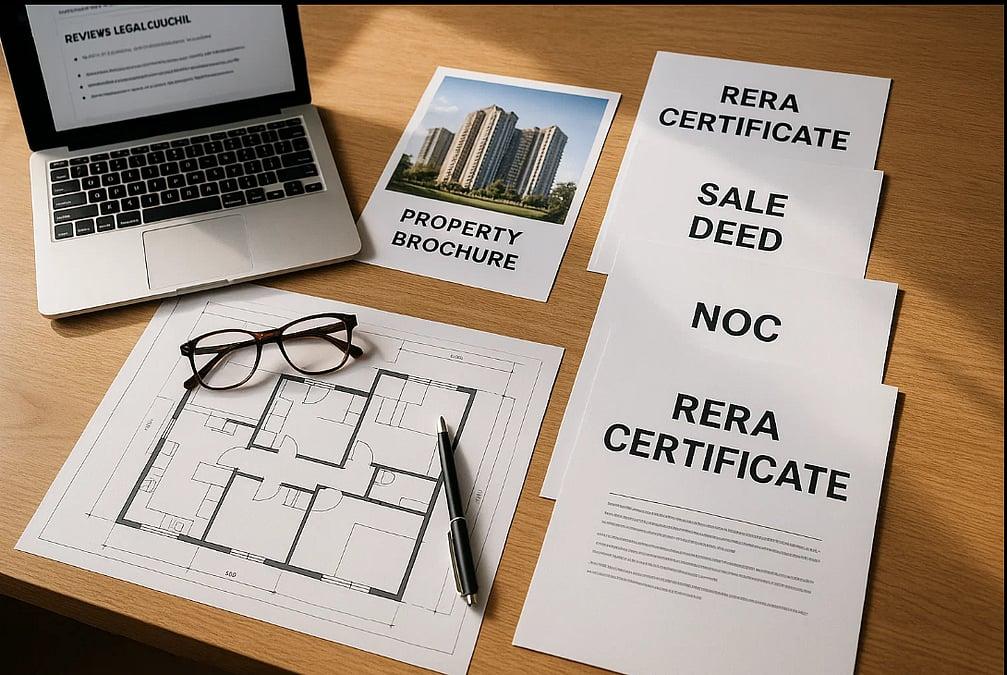
5. Don’t Confuse RERA Registration With Every Other Approval
This is one of the most important points.
RERA registration and individual statutory approvals are related but not identical concepts.
Depending on the location and type of development, a project may involve approvals relating to:
- Building plans
- Layout
- Environment
- Fire safety
- Water and sewerage
- Local development authority
- Roads and access
- Airport height restrictions
- Electricity infrastructure
The exact requirements vary by state, local authority and project.
Therefore, don’t simply ask:
“Is it RERA approved?”
Ask:
“Which approvals have actually been obtained, and can I verify them?”
6. Check the Promised Possession Date
The RERA registration normally contains important project timeline information.
Compare:
RERA completion date
with
Builder’s promised possession date
and
Agreement for Sale
These should be carefully reconciled.
RERA provides remedies where promoters fail to meet their obligations. Section 18 specifically deals with return of amounts and compensation in circumstances covered by the provision. (India Code)
The exact remedy depends on the facts, contractual documents and applicable law.
7. Monitor Construction Progress
A common mistake is:
Verify RERA → book property → never check again.
Instead, continue monitoring the project.
Compare the project’s actual construction progress with its declared timeline and updates.
If the project is supposed to be approaching completion but substantial work remains unfinished, don’t rely exclusively on verbal explanations.
Ask for documentation.
8. Search for Complaints and Orders
This could be one of the most valuable checks a buyer can perform.
Search the relevant RERA authority for the:
developer’s name + project name.
Look for:
- Complaints
- Orders
- Penalties
- Extensions
- Registration changes
- Revocation proceedings
- Non-compliance
- Refund orders
A single complaint does not automatically mean a developer is fraudulent.
But a pattern of complaints should trigger deeper investigation.
9. Check the Advertisements Against the Registered Project
This is where buyers can get caught.
The brochure may promise:
- 80% open space
- Clubhouse
- Swimming pool
- Large landscaped gardens
- Premium specifications
- Certain apartment sizes
- Multiple towers
- Future infrastructure
But the buyer should compare those claims against the legally relevant documents.
RERA Section 12 deals specifically with the promoter’s obligations regarding the veracity of advertisements and prospectuses. (India Code)
A recent Telangana RERA order illustrates why this matters: the authority found that advertising a registered project under a different name could amount to misleading representation. (Telangana RERA)
10. Read the Agreement—Not Just the Brochure
The brochure sells the dream.
The agreement defines the legal relationship.
Before signing, carefully examine:
- Possession date
- Cancellation provisions
- Payment schedule
- Interest clauses
- Carpet area
- Specifications
- Maintenance obligations
- Parking provisions
- Default provisions
- Refund provisions
- Force-majeure provisions
Never assume that every promise made verbally by a sales executive will automatically become enforceable.
If a promise is important to your purchase decision, get it documented.
A RERA Registration Is Protection—But Not a Guarantee
This is perhaps the most important distinction in this entire article.
RERA has fundamentally changed the relationship between developers and homebuyers.
The law introduced:
- Project registration
- Information disclosure
- Promoter obligations
- Financial safeguards
- Advertisement accountability
- Buyer rights
- Regulatory authorities
- Appellate mechanisms
- Penalties
- Dispute-resolution mechanisms
The Ministry of Housing and Urban Affairs continues to describe RERA as a framework intended to increase transparency and accountability and protect homebuyers. (Press Information Bureau)
But no regulatory framework can eliminate every commercial, legal or construction risk.
A project can still experience:
- Construction delays
- Financial stress
- Approval complications
- Litigation
- Management changes
- Contractor problems
- Regulatory action
- Disputes between stakeholders
The purpose of due diligence is to identify those risks before your money becomes trapped in the project.
What Should a Buyer Do Before Paying the Booking Amount?
Create a simple five-stage verification process.
Stage 1 — RERA
Verify:
Project → Promoter → Number → Phase → Location
Stage 2 — Legal
Check:
Title → Encumbrances → Approvals → Development rights
Stage 3 — Financial
Check:
Payment schedule → Escrow/separate account framework → Developer financial reputation
Stage 4 — Physical
Visit:
Actual site → Construction progress → Surrounding infrastructure
Stage 5 — Contract
Review:
Agreement → Possession → Cancellation → Refund → Specifications
For a high-value purchase, professional legal review can be worth far less than the cost of discovering a problem after booking.
The ₹1 Crore Question
Imagine two projects.
Project A
- Famous developer
- Attractive brochure
- RERA registered
- Aggressive sales team
- Excellent sample apartment
But the buyer doesn’t investigate the project record.
Project B
- RERA registration independently verified
- Promoter entity verified
- Project phase verified
- Approvals examined
- Construction monitored
- RERA orders searched
- Agreement reviewed by a lawyer
Which buyer has performed better due diligence?
Clearly, the second.
The lesson isn’t to fear every RERA project.
The lesson is to use RERA properly.
So, Is It True That People Can Still Face Problems After RERA Approval?
Yes—but the accurate statement is more nuanced.
People can still face delays, disputes, misrepresentation, regulatory problems and even project failure after a project has been registered under RERA.
Recent cases demonstrate this. A Gurugram buyer obtained a refund after a project faced serious construction and registration problems; Telangana RERA has acted against misleading project-name advertising; and other recent proceedings demonstrate that registered projects can encounter significant regulatory complications. (mint)
But this does not mean that RERA is ineffective.
In many situations, RERA gives buyers a stronger legal framework than they would otherwise have had.
The correct conclusion is:
RERA reduces risk. It does not eliminate risk.
Final Verdict: Don’t Ask Only “Is It RERA Approved?”
The next time a property salesperson tells you:
“Sir/Madam, don’t worry. The project is RERA approved.”
Don’t stop there.
Ask for the RERA number.
Open the official portal.
Check the promoter.
Check the project.
Check the phase.
Check the land details.
Check the approvals.
Check the completion date.
Check complaints and orders.
Check the construction.
Then read the agreement.
Because your biggest protection isn’t simply having a RERA number.
It is knowing what that RERA number actually tells you.
At Bhumi Nivesh, we believe real estate investment should be based not only on location and appreciation potential, but also on verification, documentation and informed decision-making.
A property may look perfect in a brochure.
Your due diligence should tell you what the brochure doesn’t.
Frequently Asked Questions
Does RERA registration guarantee that a project will be completed?
No. RERA creates regulatory obligations and remedies, but registration itself is not a government guarantee of completion or investment returns. Projects can face delays, disputes, regulatory action or other problems. (India Code)
Can a RERA-registered project lose its registration?
Yes. RERA contains provisions concerning lapse, extension and revocation of registration, and authorities can take regulatory action in appropriate circumstances. (India Code)
How can I verify a RERA project?
Use the official RERA portal of the relevant state or Union Territory and independently match the project’s registration number, name, promoter, location and phase with the documents provided by the developer.
Is a RERA number enough before buying a property?
No. It is an important starting point, but buyers should also investigate title, approvals, project progress, promoter history, complaints, agreements and other relevant documents.
What happens if a builder doesn’t deliver the property?
Depending on the circumstances, RERA provides remedies including return of amounts and applicable interest/compensation under the Act. The exact remedy depends on the facts and applicable provisions. (India Code)
Can a builder advertise a project using a different name?
A recent Telangana RERA order shows why buyers should be cautious. The authority found that advertising a registered project under a different name could create misleading representations and directed the practice to stop. (Telangana RERA)
Verified Sources & Further Reading
- Real Estate (Regulation and Development) Act, 2016 — India Code: Read the complete RERA Act on India Code (India Code)
- Ministry of Housing & Urban Affairs / Government of India — RERA implementation: Government RERA information and implementation update (Press Information Bureau)
- Telangana RERA — order concerning misleading project-name advertising: Telangana RERA order (Telangana RERA)
- Haryana RERA — recent project registration proceedings: Haryana RERA order (Haryana RERA)
- Recent Gurugram RERA refund case: Mint report on the Gurugram homebuyer case (mint)
Editorial note: RERA rules, regulations, procedures and local development approvals can differ across states/UTs. This article is intended for general information and homebuyer awareness, not as a substitute for legal advice on a specific property transaction.
