

The Discount That Can Cost More Than You Think
“ this is a special pre-launch offer. Once the project officially launches, the price will increase by ₹15–20 lakh.”
For a property buyer, this sounds like an opportunity.
A ₹1 crore apartment may be offered for ₹80–85 lakh. The salesperson says only a limited number of units are available. Friends are booking. Investors are entering. The developer is supposedly a reputed name.
You are told:
“Book now. RERA will come shortly.”
And this is where buyers need to stop and ask a very simple question:
What exactly am I paying for before the project is legally ready to be sold?

Pre-launch property buying has become one of the most discussed and controversial areas of Indian real estate. There are legitimate early-stage development structures, but there are also situations where buyers are asked to pay money before the project has obtained the necessary registration or approvals.
The risk becomes particularly serious when buyers confuse a developer’s reputation, a booking receipt, an expression of interest, an MoU, or a promised future RERA registration with the legal protection available after a project is properly registered.
India’s RERA framework was specifically designed to prevent covered projects from being marketed, booked or sold before registration with the relevant regulatory authority. The Government reiterated this position in July 2026, stating that promoters must register covered projects before advertising, marketing, booking or selling, with violations potentially attracting a penalty of up to 10% of the estimated project cost. (Press Information Bureau)
So, is every pre-launch offer a scam?
No.
But should a buyer treat an unregistered pre-launch opportunity as a normal property purchase?
Absolutely not.
What Exactly Is a Pre-Launch Property?
The term “pre-launch” is used very loosely by the Indian real estate industry.
A developer may be at different stages:
Land acquisition
↓
Planning & approvals
↓
Project structuring
↓
RERA registration
↓
Official launch
↓
Construction
↓
Possession
A genuine early-stage marketing exercise and an illegal sale of an unregistered project are not necessarily the same thing.
The critical question is:
Has the project reached the regulatory stage at which the promoter is legally permitted to market, book and sell it?
Under Telangana RERA’s official promoter guidelines, for example, a covered project cannot be advertised, marketed, booked, sold or offered for sale without registration with TGRERA, subject to the statutory exemptions. (Telangana RERA)
That principle flows from Section 3 of the RERA Act.
Therefore, when someone tells you:
“RERA registration will come next month, but you can book today.”
that statement deserves serious scrutiny.
Why Do Developers Offer Pre-Launch Prices?
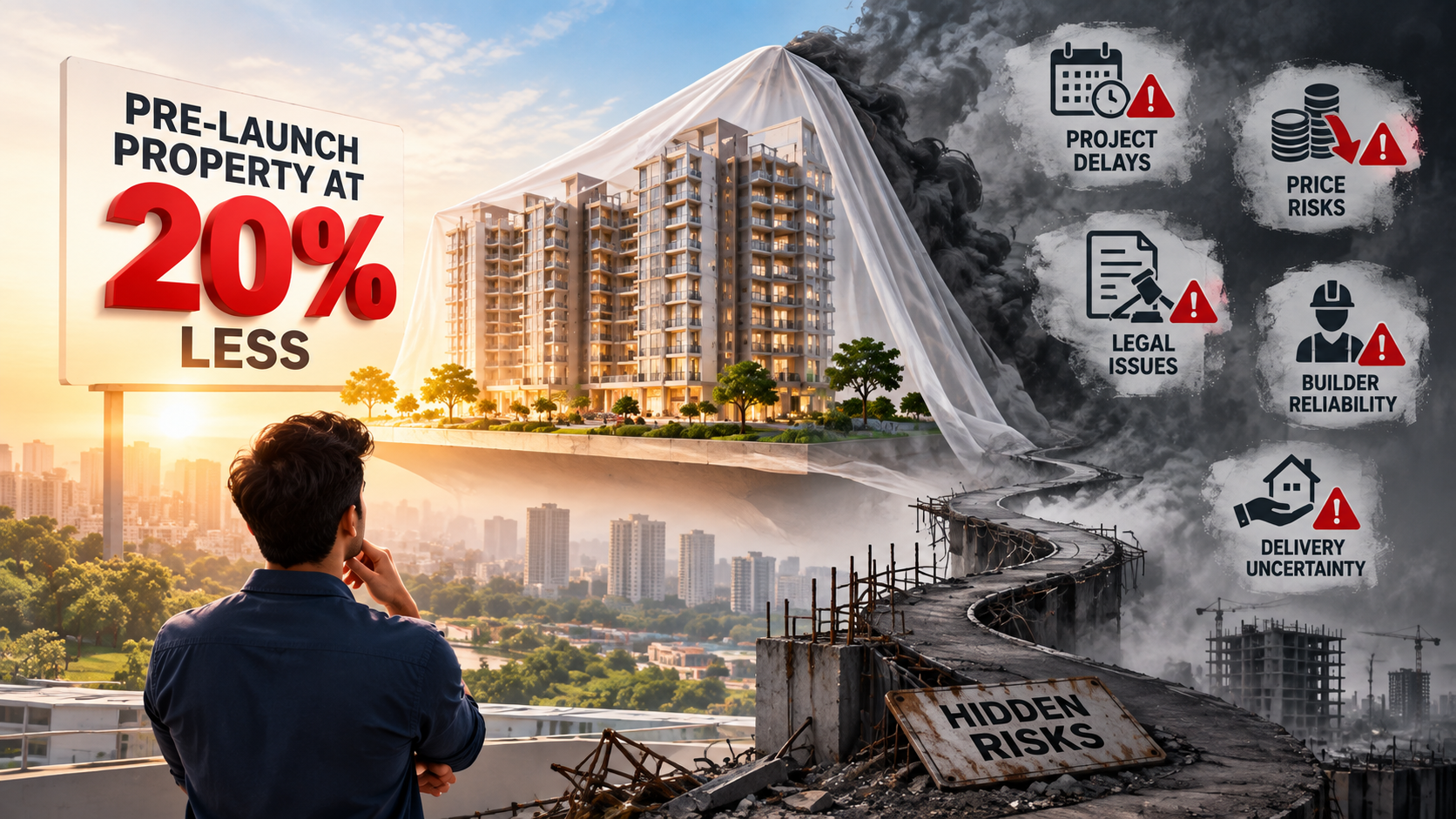
There can be legitimate commercial reasons for generating early demand.
Developers may want to:
- Test market demand
- Build a buyer pipeline
- Generate publicity
- Establish initial pricing
- Prepare for a formal launch
- Create early investor interest
The real estate industry also uses terms such as:
- Pre-launch
- Soft launch
- Early access
- Expression of interest
- Priority booking
- Founder pricing
- Investor allocation
But the terminology itself doesn’t determine legality.
The documents and regulatory status do.
A buyer should never assume that calling a payment an “EOI” or “pre-launch contribution” automatically takes it outside RERA.
The Biggest Mistake: Confusing a Big Brand With a Safe Project
This is particularly important for India’s real estate fraternity.
A well-known developer can have:
- A strong brand
- Thousands of completed homes
- Institutional investors
- Large land holdings
- Excellent marketing
- Multiple successful projects
Yet every new project still has to be evaluated on its own legal and regulatory status.
This is not an accusation against major developers.
In fact, Telangana RERA’s official website currently lists suo motu proceedings involving several well-known developers, including Prestige Estates Projects Limited, Godrej Properties Limited, My Home Constructions and Aparna Constructions. (Telangana RERA)
Important clarification
The appearance of a company on a RERA proceedings/order list does not by itself mean that the company committed fraud or that every project of that company is problematic.
It simply demonstrates an important investment principle:
Even a large brand is not a substitute for project-specific due diligence.
A buyer should investigate the specific project, specific phase and specific legal entity.
A Real Pre-Launch Failure: Bharathi’s Lake View
One of the clearest examples comes from Telangana.
In a September 2025 suo motu proceeding, TGRERA recorded allegations concerning Bharathi’s Lake View Apartments at Kompally.
According to the authority’s order, representations alleged that more than 400 allottees had paid approximately ₹70 crore in aggregate through what were described as pre-launch offers between 2019 and 2023.
The order recorded allegations that the project had not been registered under RERA and that required statutory approvals had not been obtained. It also recorded allegations that physical development had not commenced despite substantial advances being collected from buyers. (Telangana RERA)
The case subsequently resulted in further relief for buyers.
In August 2026, TGRERA ordered refunds with 10.7% annual interest to 12 homebuyers connected with the project after finding that the project had failed to take off despite payments being collected. (The Times of India)
This case illustrates the danger of a pre-launch proposition perfectly:
The problem isn’t the discount.
The problem is paying significant money before the underlying project has reached the necessary regulatory and development stage.
What Happens When a Pre-Launch Project Fails?
Let’s understand the typical risk cycle.
Step 1: The Big Promise
The buyer hears:
“Official launch price will be much higher.”
Step 2: The Early Payment
The buyer pays:
- ₹5 lakh
- ₹10 lakh
- ₹20 lakh
- or sometimes much more
through an EOI, booking, MoU or other arrangement.
Step 3: The Launch Gets Delayed

The promised launch date moves.
First:
“Next month.”
Then:
“Approval is almost done.”
Then:
“RERA registration is coming.”
Step 4: Construction Doesn’t Start
The buyer visits the site.
There may be:
- No boundary wall
- No excavation
- No foundation
- No construction equipment
- No visible development
Step 5: The Buyer Wants a Refund
Now the situation becomes much more complicated.
The buyer isn’t simply waiting for possession of a completed RERA project.
They may first have to establish:
- What was actually purchased?
- What agreement was signed?
- Who received the money?
- Was the project registered?
- Were approvals obtained?
- What refund obligation exists?
- Which legal remedy applies?
Why RERA Registration Matters So Much
RERA was introduced to make the real estate market more transparent and accountable.
For registered projects, promoters are required to provide substantial project information, including relevant approvals and other disclosures.
The RERA framework also requires significant financial discipline. Government rules provide for 70% of amounts collected from allottees for a project to be deposited into a separate bank account, subject to the statutory framework, to cover land and construction costs. Promoters also have continuing disclosure obligations regarding project progress and approvals. (Press Information Bureau)
This creates a much stronger information and regulatory framework than simply handing money to someone based on a future promise.
That’s why the distinction matters:
RERA-registered project
is fundamentally different from
“RERA registration coming soon.”
The UDS Trap: When the Deal Looks Like a Flat But the Structure Is Different
Another area buyers need to understand—particularly in markets such as Hyderabad—is Undivided Share of Land (UDS).
Some property structures involve buyers acquiring an undivided share in land together with rights associated with construction.
This can be legitimate when properly structured and documented.
The danger arises when a buyer doesn’t understand what they are legally purchasing.
A Telangana RERA proceeding, for example, recorded a buyer’s allegation that they had sought registration of their UDS but were told the promoter did not have possession of the land necessary for registration. The same proceeding recorded allegations that the developer did not have the necessary approvals or RERA registration for the project. (Telangana RERA)
Therefore, when someone says:
“You’re not buying a flat now; you’re buying UDS first.”
don’t simply sign.
Ask a property lawyer to explain exactly what ownership rights you are acquiring.
The 12-Step Pre-Launch Property Safety Checklist
Before paying even a token amount, follow these steps.
1. Check RERA Registration
Search the official state RERA portal.
Don’t rely on a screenshot provided by the salesperson.
2. Verify the Exact Project
Check:
- Project name
- Phase
- Location
- Survey numbers
- Promoter
A developer may have multiple projects with similar names.
3. Verify the Legal Promoter
The brand name isn’t enough.
Identify the actual legal entity receiving your money.
4. Check Land Title
Ask for professional verification of:
- Title
- Ownership
- Encumbrances
- Development rights
- Joint-development agreements, where applicable
5. Check Development Approvals
Depending on the project, investigate:
- Layout approval
- Building permission
- Environmental approvals
- Fire approvals
- Water/sewerage permissions
- Other local statutory approvals
6. Check Whether Construction Has Actually Started
Don’t confuse:
land acquisition
with
project development.
Visit the site.
7. Check the Payment Recipient
Where exactly is your money going?
Developer?
Landowner?
Marketing company?
Agent?
Separate entity?
This matters.
8. Read the EOI/MoU/Agreement
Never assume that an EOI is “just a formality.”
Have the document reviewed.
9. Ask What Happens If RERA Registration Is Refused
This question should be mandatory.
Ask:
“If the project doesn’t receive RERA registration, when and how will my money be refunded?”
Get the answer in writing.
10. Check the Promoter’s RERA History
Search:
Developer name + RERA
and look for:
- Orders
- Complaints
- Penalties
- Lapsed projects
- Suo motu proceedings
RERA authorities publish extensive records. Haryana RERA, for example, publicly identifies projects with statuses such as “Lapsed Project” and provides project monitoring information. (Haryana RERA)
11. Check the Developer’s Existing Projects
Don’t only ask:
“Which projects have you completed?”
Ask:
“Which projects have been delayed, litigated, surrendered or substantially changed?”
A company’s complete track record is more useful than its best project.
12. Never Let the Discount Create Artificial Urgency
The most dangerous sentence in real estate can be:
“Today is the last day for this price.”
If the project is genuinely attractive, it should survive 48 hours of legal due diligence.
A genuine opportunity should withstand questions.
What If the Developer Is a Major National Brand?
This is where buyers sometimes become overconfident.
A major developer reduces certain risks—but doesn’t eliminate project-specific risks.
A national brand can still face:
- Approval delays
- Litigation
- Regulatory proceedings
- Construction delays
- Market changes
- Financing issues
- Land-related complications
Again, this doesn’t mean large developers are unsafe.
It means:
Brand reputation should be one factor—not your entire due-diligence strategy.
The Telangana RERA website’s 2025–26 suo motu listings themselves demonstrate why project-specific scrutiny remains important even when the promoter is a recognized name. (Telangana RERA)
Is Every Pre-Launch Property a Scam?
No.
This distinction is essential.
Some early-stage property opportunities may ultimately become successful projects.
A developer may genuinely be:
- Acquiring land
- Obtaining permissions
- Structuring the project
- Preparing RERA documentation
- Preparing for an official launch
The problem begins when buyers are asked to provide substantial money before the legal and regulatory foundation is sufficiently established, or when the transaction is represented as something safer or more advanced than it actually is.
Therefore:
Pre-launch does not automatically mean fraud.
But:
“RERA later” should never be treated as equivalent to “RERA today.”
The Real Estate Fraternity Has a Role to Play
This issue isn’t only about buyers and builders.
The broader real estate fraternity—including:
- Developers
- Brokers
- Channel partners
- Property consultants
- Lawyers
- Financial institutions
- RERA authorities
- Industry associations
has a role in improving transparency.
Responsible developers should clearly distinguish between:
expression of interest
and
legal booking/sale.
Responsible brokers should not create artificial urgency or make guarantees that aren’t supported by documentation.
And buyers should demand documentation instead of relying on verbal assurances.
The ₹20 Lakh Discount Test
Suppose a completed and properly launched property costs:
₹1 crore
An early-stage offer is:
₹80 lakh
Your apparent saving:
₹20 lakh
But ask yourself:
What risks am I accepting for that ₹20 lakh?
- Is the land title verified?
- Is the project registered?
- Are approvals in place?
- Is construction permitted?
- Can the project legally be sold?
- Where is my money going?
- What happens if the launch doesn’t happen?
- How quickly can I recover my money?
If you cannot answer those questions, the ₹20 lakh isn’t a discount.
It’s compensation for risk you haven’t fully understood.
Pre-Launch vs RERA-Registered: A Simple Comparison
| Factor | Pre-Launch Opportunity | RERA-Registered Project |
|---|---|---|
| RERA status | May be pending | Registration available |
| Project information | Potentially limited | Regulatory disclosures available |
| Approvals | May still be progressing | Greater visibility into required disclosures |
| Construction | Often early/no construction | Project status can be monitored |
| Buyer protection | Depends heavily on legal structure | RERA framework applies |
| Project risk | Generally higher | Generally lower, but not zero |
| Price | Often marketed as discounted | Usually higher after launch |
| Due diligence | Extremely important | Still essential |
Important: RERA registration does not make a property risk-free. It creates a regulatory framework and buyer protections, but project-specific legal and commercial risks can remain.
The Golden Rule for Property Buyers
Before paying for a property, remember this sequence:
Verify → Investigate → Document → Then Invest
Not:
Discount → Emotion → Booking → Questions Later
The biggest advantage of buying early isn’t necessarily getting the lowest price.
The biggest advantage is being able to identify risk before committing your money.
Conclusion: The Cheapest Property Isn’t Always the Cheapest Investment
India’s real estate market is entering a new phase.
Projects are becoming larger, investment sizes are increasing, national developers are expanding across cities, and buyers are increasingly being presented with sophisticated early-stage investment opportunities.
That makes financial literacy and legal due diligence more important than ever.
A pre-launch offer can sometimes provide an attractive price.
But a cheap property with unclear approvals, uncertain land rights, delayed registration or an unreliable refund mechanism can ultimately become far more expensive than a property purchased at a higher but safer stage.
The lesson from cases such as Bharathi’s Lake View is not that every pre-launch project is fraudulent. It is that buyers who transfer substantial sums before verifying the project’s legal and regulatory foundation can face serious consequences if the development doesn’t materialize. TGRERA’s proceedings in that matter demonstrate both the scale of money that can become involved and the importance of regulatory remedies. (Telangana RERA)
And the lesson for buyers considering even the biggest names in the industry is equally simple:
Never buy a project solely because you trust the brand. Buy it because you have verified the project.
A famous developer can attract you to a property.
A discount can convince you to book it.
But documentation, approvals and due diligence are what protect your investment.
In real estate, the best time to ask difficult questions is before you pay—not after the project fails.
Frequently Asked Questions
Is buying a pre-launch property illegal in India?
Not every situation described as “pre-launch” is automatically illegal. However, Section 3 of RERA generally requires covered projects to be registered before advertising, marketing, booking or selling. Specific statutory exemptions can apply. Buyers should verify the project’s legal status with the relevant state RERA authority. (Press Information Bureau)
Can a builder collect money before RERA registration?
For a covered project, promoters generally cannot advertise, market, book or sell before registration. The exact legal position depends on the nature of the transaction and statutory exemptions, so buyers should obtain legal advice for a specific deal. (Press Information Bureau)
Is a pre-launch property always cheaper?
Not necessarily. A developer may advertise an early price below the eventual launch price, but buyers are also accepting greater uncertainty. The “discount” should therefore be evaluated against the additional risk.
Should I buy from a famous builder without checking RERA?
No. A strong developer reputation is valuable, but each project should be independently verified. RERA’s official Telangana records, for example, contain proceedings involving both smaller developers and well-known national brands. (Telangana RERA)
What is UDS in a property purchase?
UDS means Undivided Share of Land. It represents an undivided interest in the underlying land associated with a property. The exact legal structure varies by project and agreement, so buyers should have the documents professionally reviewed.
What should I do if I already paid money for a pre-launch project?
Collect the payment receipts, MoU/EOI, promotional material, correspondence, bank records and all project documents. Check the relevant RERA authority’s records and consult a qualified property lawyer about the appropriate remedy.
Verified Sources & Further Reading
- Real Estate (Regulation and Development) Act, 2016 — India Code
- Government of India — RERA implementation update, Ministry of Housing & Urban Affairs / PIB
- Telangana RERA — Promoters Guidelines
- Telangana RERA — Suo Motu Orders
- TGRERA order concerning Bharathi’s Lake View Apartments
- Times of India — TGRERA refund orders in Bharathi Lake View case
- Haryana RERA — Registered Projects & Project Status
- Government of India — RERA rules and project disclosure framework
Editorial note: RERA requirements, exemptions, local development permissions and remedies can vary by state and by the specific legal structure of a transaction. This article is intended for general homebuyer education and should not replace project-specific legal, title or financial advice.
