
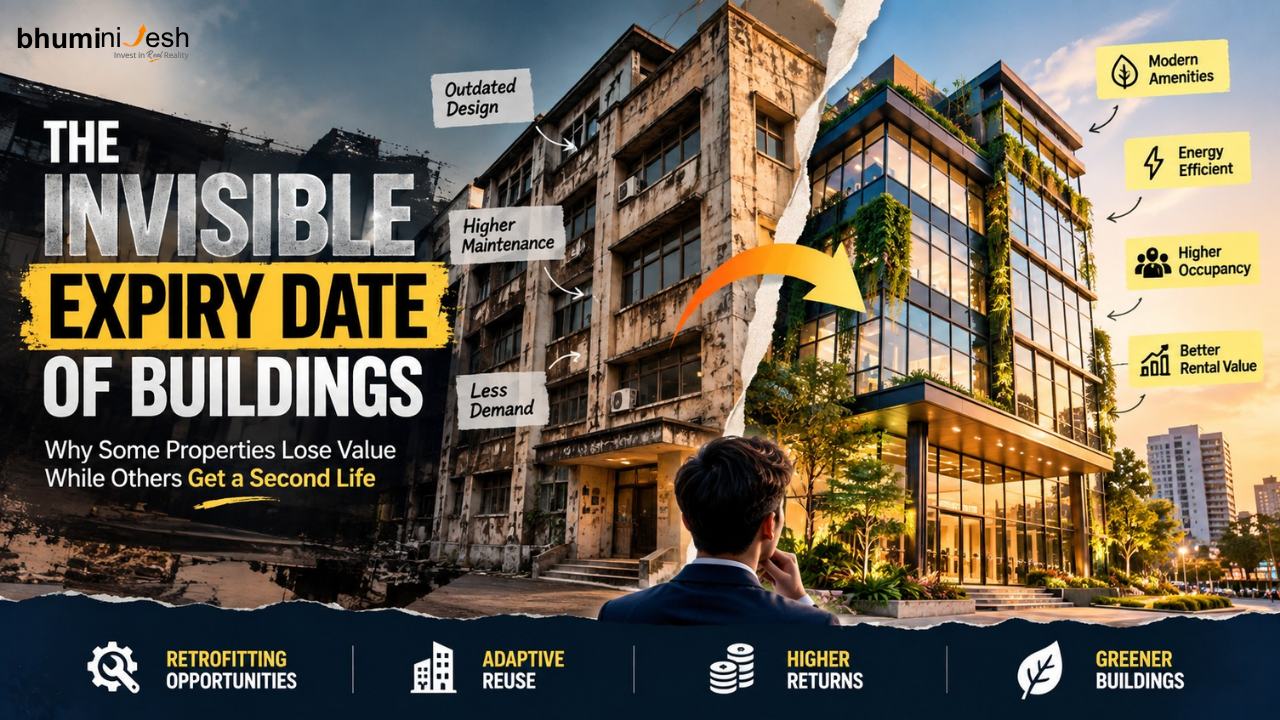

Introduction: A Property Can Age Without Falling Apart
Imagine two office buildings standing on the same road. Both are structurally sound, located in a busy commercial district and surrounded by transport links, restaurants and residential neighbourhoods.
The first building has outdated lifts, inefficient air-conditioning, poor parking, limited natural light and no modern energy-management systems. The second has been upgraded with efficient cooling, better lighting, flexible office layouts, improved accessibility and modern shared facilities.
Despite their similar locations, tenants may increasingly prefer the second building. The first might have to offer discounts, spend more on maintenance or accept longer periods without tenants.
Neither building has necessarily reached the end of its physical life. Yet one may already be losing its competitive position.
This is the invisible expiry date of buildings: the point at which a property no longer meets market expectations as effectively as its competitors.
In real estate, this phenomenon is known as obsolescence. It can affect residential apartments, shopping centres, hotels, factories, warehouses and office buildings. For investors, it raises an important question: should an ageing property be renovated, repurposed, redeveloped or sold?
The answer can determine whether a building becomes a long-term asset or an increasingly expensive liability.
1. What Is Building Obsolescence?

Building obsolescence occurs when a property loses usefulness, desirability or competitiveness. This does not automatically mean that its structure is unsafe or that its market price must fall. It means the building may no longer serve its intended users as effectively as newer or better-adapted alternatives.
There are three important types.
Physical obsolescence: Components deteriorate through age and use. Examples include leaking roofs, ageing plumbing, damaged façades, failing lifts and worn electrical systems.
Functional obsolescence: The design or facilities no longer suit current needs. A residential apartment may have inadequate parking, an inconvenient layout or insufficient electrical capacity. An office may lack flexible workspaces, reliable connectivity or suitable ventilation.
External or economic obsolescence: Factors outside the building reduce its appeal. A new road alignment, changing commercial district, increased congestion, nearby industrial pollution or a shift in local demand may affect the property’s usefulness.
These categories can overlap. An old building may need physical repairs, functional improvements and a response to changing neighbourhood conditions at the same time.
For investors, identifying the correct type of obsolescence is the first step towards deciding whether an upgrade is worthwhile.
2. Why Buildings Become Outdated Faster Than Expected

Buildings are expensive, long-term assets, but the expectations of their occupants change much faster than their structures.
Consider a commercial building designed twenty years ago. Its original design may have prioritised usable floor space and basic air-conditioning. Today’s prospective tenants may also expect reliable digital infrastructure, efficient cooling, better indoor air quality, charging facilities, flexible meeting rooms and lower operating costs.
A residential building faces a similar challenge. Buyers and tenants may increasingly value functional kitchens, usable balconies, secure access, lifts, parking, power backup, good water management and spaces that accommodate working from home.
Not every buyer wants every feature. Preferences vary by location, budget and property type. However, a building that consistently fails to meet the expectations of its target market may find it harder to attract tenants or justify its asking rent.
Climate also matters. Heat, water stress, extreme rainfall and rising cooling requirements can expose weaknesses in buildings that were not designed for today’s conditions.
The lesson is simple: a building’s age is less informative than its condition, functionality, operating costs and relevance to the market.
3. India’s ₹45,000 Crore Opportunity Hidden Inside Older Offices

The scale of this issue is visible in India’s commercial real estate market.
In April 2025, real estate consultancy JLL estimated a ₹45,000 crore opportunity to retrofit and upgrade office buildings across India’s seven major office markets. Its analysis estimated that approximately 62% of Grade A office stock in those markets—around 530.8 million square feet—required interventions ranging from lighter upgrades to more substantial improvements.
The markets included Bengaluru, Chennai, Delhi NCR, Hyderabad, Kolkata, Mumbai and Pune. Bengaluru, Delhi NCR, Mumbai and Hyderabad accounted for around 81% of the estimated investment opportunity.
Why is this significant?
Because a substantial part of real estate’s future value may come not only from constructing new buildings, but also from improving buildings that already exist.
JLL estimated that successfully upgraded assets could potentially achieve rental premiums of 15–30% over non-retrofitted properties, with some submarkets offering higher premiums. These are consultancy estimates, not guaranteed returns for every building or investor. Actual outcomes depend on the upgrade, location, tenant demand, cost and competing supply.
The broader opportunity is to identify buildings whose locations remain valuable but whose facilities have fallen behind.
A well-located building with correctable weaknesses may deserve a closer look than an apparently modern building in a location with limited demand.
4. The Difference Between a Bad Property and an Underperforming Asset

An ageing property is not automatically a poor investment. In some cases, it may simply be underperforming because its owner has not adapted it to current market requirements.
Imagine an office building with a strong location, convenient public transport access and established corporate neighbours. Its common areas are dated, lighting is inefficient and the air-conditioning system consumes excessive electricity.
A new building might compete more effectively for tenants, but the older property has an advantage that cannot easily be recreated: its existing location.
The owner could investigate replacing inefficient equipment, improving the lobby, upgrading lifts, redesigning shared spaces and improving energy performance.
If the upgrades help attract and retain tenants, the building may become more competitive without requiring demolition.
However, there is an important distinction between fixable weaknesses and fundamental disadvantages.
A dated lobby can be renovated. A poorly located building cannot be moved. An inefficient lighting system can be replaced. A structurally unsuitable floor plate may be much harder or more expensive to correct.
Before investing, owners must determine which problems can realistically be solved and which are inherent in the asset.
5. Retrofitting: Giving an Old Building a New Competitive Advantage

Retrofitting means improving an existing building rather than relying entirely on new construction. The work can range from replacing a few systems to undertaking a comprehensive upgrade.
Potential interventions include:
- Energy efficiency: Upgrading lighting, cooling equipment, controls and insulation where appropriate.
- Water management: Improving plumbing, detecting leaks, upgrading fixtures and managing rainwater.
- Building systems: Modernising lifts, electrical distribution, fire-safety systems and backup arrangements.
- Occupant experience: Improving accessibility, common areas, ventilation, lighting and usable space.
- Technology: Introducing suitable access controls, energy monitoring, security systems and building-management tools.
- Climate resilience: Addressing heat gain, drainage, waterlogging risks and other location-specific hazards.
India’s Bureau of Energy Efficiency provides guidance and technical resources for improving the energy performance of existing residential and commercial buildings. Its resources include retrofit manuals and material on energy-efficient building systems.
Not every property needs every intervention. A small apartment building may benefit most from repairing water systems, improving common areas and maintaining lifts. A large office complex may need a detailed engineering assessment of cooling, lighting and building controls.
The objective is not to make an old building look new at any cost. It is to improve the features that matter to its occupants and financial performance.
6. Can Green Buildings Command Higher Rents?

Energy-efficient buildings can potentially offer advantages beyond lower resource consumption. They may also appeal to tenants seeking better working environments, more predictable operating costs and sustainability credentials.
A 2024 peer-reviewed study by researchers associated with the Indian Institute of Management Ahmedabad and other institutions analysed more than 17,000 green and health-certified office rental contracts in India from 2010 to 2022. It found that rents in green-labelled and health-certified assets carried premiums of approximately 4–21% in the studied data.
That finding is useful, but it needs careful interpretation. It does not mean that adding a green feature to any building will automatically increase rent by a fixed percentage. Certification, location, building quality, tenant type, lease terms and market conditions all influence rental outcomes.
For a property owner, the practical question is whether the cost of the improvement is justified by measurable benefits: lower utility expenses, stronger tenant demand, reduced vacancies, improved lease renewals or a combination of these factors.
An upgrade that looks impressive but does not solve a tenant problem may produce disappointing financial results.
7. The Most Interesting Opportunity: Giving Buildings a Different Purpose

Sometimes a building is no longer suitable for its original use, even after reasonable upgrades. That does not necessarily mean the structure has no future.
Adaptive reuse involves converting an existing building for a different purpose, subject to structural suitability, planning rules, building codes and necessary approvals.
Examples may include:
- An old industrial building converted into offices or creative workspaces.
- A dated commercial property redesigned for clinics, training centres or service businesses.
- A former warehouse adapted for suitable storage, logistics or light commercial use.
- An older hospitality property renovated for a different accommodation model.
- A large, underused building reconfigured into smaller units for multiple occupiers.
The idea is attractive because the building may already have useful features such as a large floor plate, access roads or an established urban location. Reusing it may preserve some of that value.
But conversion is not simply a matter of changing the interiors. Residential, commercial, healthcare, hospitality and industrial uses have different requirements. A change of use may require planning permission, fire-safety compliance, structural modifications, parking provisions, utility upgrades and other approvals.
A building that appears cheap because it is vacant may become expensive once all the required work is calculated.
The best adaptive-reuse opportunities start with a feasible new purpose—not just a low purchase price.
8. Residential Property: When an Old Apartment Needs More Than Paint

Building obsolescence is not limited to commercial offices. It can affect residential apartments and housing societies just as significantly.
An older apartment in a well-connected neighbourhood may still be attractive because it offers access to established markets, public transport, healthcare and employment centres. Meanwhile, a newer project farther away may offer more amenities but require a longer commute.
Yet the older property could have issues that gradually affect its appeal: recurring water leakage, ageing plumbing, inadequate parking, poor lift reliability, outdated electrical systems or expensive common-area maintenance.
In apartment communities, the condition of shared infrastructure matters because an individual owner cannot independently fix every building-wide problem. Repairs may depend on the housing society’s finances, maintenance planning, owner participation and applicable legal procedures.
Before buying an older apartment, investigate:
- The condition of the structure and common areas.
- The age, maintenance history and condition of lifts and essential systems.
- Water supply, drainage and waterproofing.
- Parking availability and whether the allocation is documented.
- Society maintenance charges, outstanding dues and planned major repairs.
- Any required permissions and legal restrictions affecting renovation or redevelopment.
An older apartment with strong fundamentals and a well-managed society may be a sensible purchase. Another apartment of the same age may carry substantial repair costs and governance risks.
Age alone is not a reliable investment strategy. The real question is what you are buying—and what you will need to spend after possession.
9. The Investor’s Calculation: Will the Upgrade Actually Pay?

Before purchasing or renovating an underperforming building, investors should compare the total cost with the realistic financial benefits.
Consider a hypothetical example.
An investor owns a small commercial property generating ₹12 lakh in annual rent. The building needs ₹20 lakh of upgrades. After the work, assume the property can generate ₹15 lakh annually because of improved occupancy or rent.
The additional annual rental income is ₹3 lakh.
The simple payback period on the ₹20 lakh upgrade cost would be approximately 6.7 years, assuming the additional income is achieved and maintained.
That calculation is only a starting point. It excludes financing, taxes, maintenance, vacancy, rent-free periods, operating expenses, future capital expenditure and the time needed to complete the work. It also assumes that the original rental income continues and that the increase is actually achievable.
A stronger assessment would compare net operating income before and after renovation and account for the risk of delays or lower-than-expected demand.
Investors should also compare renovation with alternative options, such as selling the property, leasing it in its current condition, or redeveloping it where permitted.
A project that increases rent may still destroy value if the upgrade costs too much. Conversely, a modest improvement may be worthwhile if it reduces vacancies, prevents deterioration or extends the building’s useful commercial life.
10. A Practical Checklist Before Investing in an Ageing Property

Use this checklist before buying, renovating or repositioning an older asset.
- Verify the structure. Obtain an appropriate professional assessment of structural condition and safety. Do not rely only on appearance or the seller’s assurances.
- Identify the target occupant. Determine who is likely to rent or buy the property after the proposed work. Speak to local brokers, prospective tenants and relevant businesses.
- Separate cosmetic issues from technical problems. Repainting is different from repairing waterproofing, replacing electrical infrastructure or strengthening structural components.
- Obtain a detailed cost estimate. Include professional fees, approvals, temporary vacancy, contingency, financing and future maintenance—not just contractor quotations.
- Check permissions and compliance. Confirm land use, sanctioned plans, occupancy status, fire-safety requirements and any permissions required for renovation or change of use.
- Test the local market. Compare achievable rents, vacancy levels and competing properties. Asking prices are not proof of actual demand.
- Calculate the downside. What happens if the project costs 20% more, takes six months longer or generates less rent than expected? Consider whether the investment remains viable.
- Compare alternatives. Evaluate renovation, continued operation, sale and redevelopment where legally and practically possible.
- Plan long-term maintenance. A building should not merely look better immediately after renovation. Its systems need a realistic maintenance budget and operating plan.
- Set a measurable objective. Decide whether the upgrade is intended to reduce expenses, attract tenants, improve rent, extend useful life or prepare the asset for a different use.
This process turns an attractive renovation story into an investment decision based on evidence.
11. What This Means for India’s Future Real Estate Market

As Indian cities expand and existing neighbourhoods mature, real estate investment will involve more than identifying land for new construction. Owners and investors will also need to understand how existing buildings can adapt to changing technology, environmental conditions and occupant expectations.
Some buildings will benefit from targeted maintenance. Others will need major retrofits. A smaller number may be suitable for a different use or redevelopment. And some will remain difficult investments because their structural limitations, location or costs make adaptation uneconomical.
This creates an opportunity for more careful property analysis. Instead of asking only whether a building is old, investors can ask whether it remains useful, competitive and financially sustainable.
The most successful upgrades are likely to be those that solve genuine problems for occupants while respecting the technical and financial limits of the asset.
Ageing buildings are not automatically future liabilities. But neither are they hidden goldmines simply waiting for renovation.
Their future depends on the relationship between location, building condition, user demand, upgrade costs and execution.
Conclusion: The Best Property May Not Be the Newest One
The next real estate opportunity may not always be a newly launched residential tower or a commercial project on the outskirts of a growing city. In some cases, it may be an existing building whose location remains valuable but whose design and facilities need to catch up with the market.
For buyers, this means looking beyond the building’s age and advertised price. For owners, it means maintaining assets before small problems become expensive ones. For investors, it means understanding whether renovation or adaptive reuse can generate enough value to justify the capital required.
At Bhumi Nivesh, the larger lesson is that real estate value is not fixed at the time of construction. It is continually shaped by how well a property serves the people who use it.
A building may lose relevance long before it reaches the end of its physical life. With the right diagnosis and a financially sound plan, some buildings can earn a second life.
The challenge is knowing which ones deserve that investment.
Frequently Asked Questions
1. What is building obsolescence in real estate?
Building obsolescence occurs when a property loses usefulness or competitiveness because of physical deterioration, outdated design, changing user expectations or external factors affecting its location.
2. Does an old property always lose value?
No. An older property in a strong location may remain attractive, especially if it is well maintained. Its value depends on factors such as condition, demand, maintenance costs, functionality and competing properties.
3. What is retrofitting in real estate?
Retrofitting means upgrading an existing building’s systems or features. This can include improvements to lighting, cooling, electrical systems, water management, accessibility, safety and energy performance.
4. Can renovating an old commercial building increase rental income?
It can, if the upgrades address tenant needs and improve the property’s competitiveness. However, higher rent is not guaranteed. The investment cost, location, market demand and quality of execution all matter.
5. What is adaptive reuse?
Adaptive reuse is the conversion of an existing building to a different purpose. For example, an industrial building may be converted into offices, subject to structural suitability, local planning rules and the required approvals.
6. Is an older apartment a good investment?
It can be, particularly when it offers a desirable location and sound building management. Buyers should investigate structural condition, major repair requirements, society finances, maintenance costs, legal status and redevelopment assumptions before investing.
Sources and Further Reading
- JLL — Upgrading India’s Office Buildings: INR 45,000 Crore Opportunity — research on office retrofitting and potential rental premiums.
- JLL — Futureproofing 4.0: Opportunity Through Obsolescence — analysis of commercial building upgrades in India’s major office markets.
- Bureau of Energy Efficiency, Government of India — building energy-efficiency resources and retrofit manuals.
- Indian Institute of Management Ahmedabad — Research on Green and Healthy Building Rental Contracts — research examining rental premiums and green-building labels in India.
Editorial note: This article is for general information and investment education, not a recommendation to buy, renovate or redevelop any specific property. Actual returns depend on local market conditions, professional assessments, costs and approvals.
