
The Education Effect: How Schools & Universities Are Creating India’s Next Real Estate Hotspots
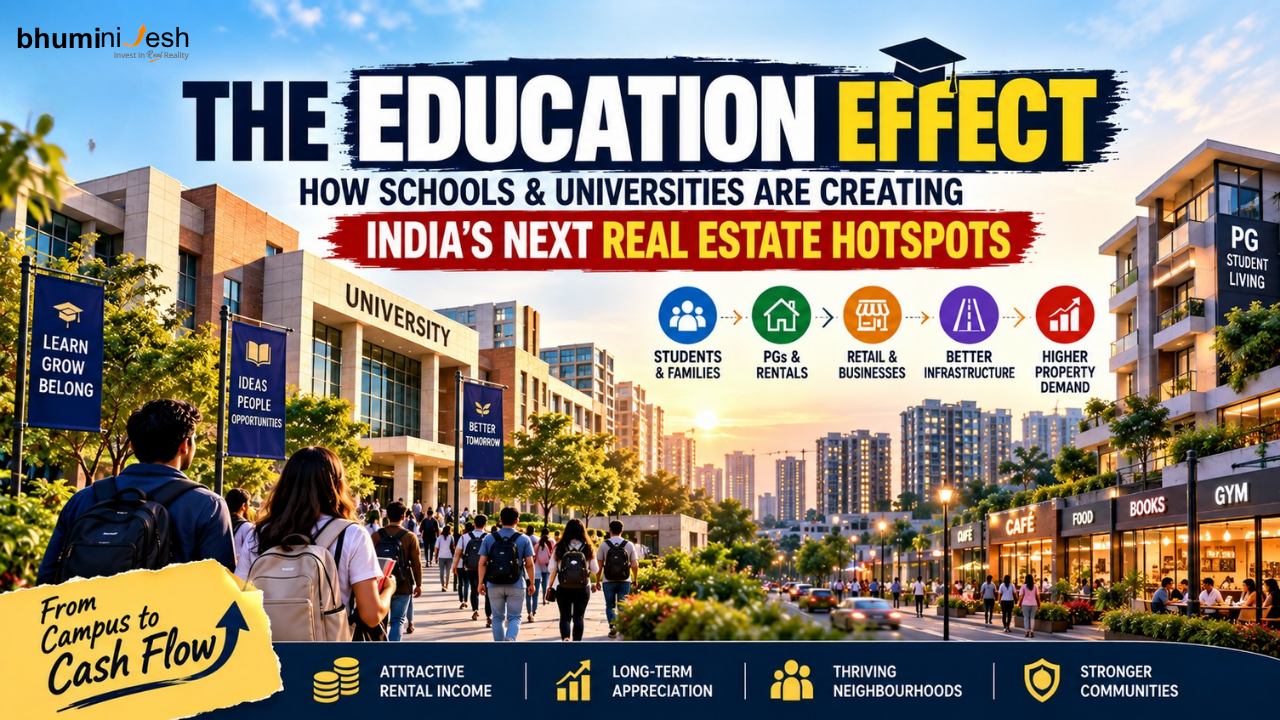
The Education Effect: When a Campus Becomes a Real Estate Engine
What if the next real estate hotspot in India doesn’t begin with a highway, airport or metro station?
What if it begins with a school or university campus?
A major educational institution can bring thousands of students, faculty members and staff into an area. Those people need accommodation, food, transportation, healthcare, retail, entertainment and everyday services. Over time, that demand can encourage developers and investors to build housing and commercial infrastructure around the education cluster.
This creates a powerful real-estate cycle:
Education → Students → Rental Demand → PGs & Hostels → Retail → Infrastructure → Housing → Local Economic Activity.
That does not mean every property near a school or university will automatically appreciate. But it does mean education infrastructure can be an important demand driver that property buyers and land investors should investigate.
India’s Education Market Is Creating a Massive Housing Demand
The scale of India’s higher-education ecosystem makes this particularly interesting for real estate.
According to the Ministry of Education’s AISHE 2021–22, India’s higher-education enrolment reached approximately 4.33 crore students, up from 3.42 crore in 2014–15—a rise of about 26.5%. The latest Ministry annual report gives a higher-education Gross Enrolment Ratio of 29.5% for 2022–23, compared with 23.7% in 2014–15.
This matters because a significant portion of higher-education students study away from their home towns. When students migrate to another city, they require somewhere to live. That creates demand for university hostels, private hostels, PG accommodation, co-living spaces, shared apartments and conventional rental housing.
JLL has highlighted this student-housing opportunity in India. In a 2024 Mumbai student-housing transaction, JLL cited a deficit of more than 7 million student beds and projected that the gap could approach 20 million beds as higher-education enrolment and migrant-student populations expand. JLL’s figures are market estimates and should not be treated as a government housing count, but they demonstrate the scale of the accommodation challenge identified by the sector.

This Is Where the PG Investment Story Begins
Imagine a university with thousands of students but insufficient on-campus accommodation.
Students start looking outside the campus.
First, they rent rooms in nearby houses.
Then landlords convert floors into PG accommodation.
Entrepreneurs establish hostels.
Developers notice the demand and introduce co-living and purpose-built student housing.
Restaurants, cafés, laundry services, stationery shops, gyms and convenience stores follow.
Suddenly, land that once appeared to be on the outskirts of the city has developed an entirely new rental ecosystem.
This is why university locations can be interesting to property investors—not because proximity automatically guarantees returns, but because a large, recurring population can create recurring accommodation demand.
From One University to an Entire Education Corridor
The real opportunity becomes more interesting when multiple institutions cluster together.
Consider an area containing:
- A university
- Engineering colleges
- Medical colleges
- Management institutes
- Schools
- Coaching centres
- Research institutions
- Skill-development centres
Instead of having one source of demand, the locality develops an education ecosystem.
Different institutions may have different academic calendars, student demographics and accommodation requirements. That can broaden the potential tenant pool for nearby housing and supporting businesses.
This is one reason education clusters can have a different real-estate dynamic from a single isolated campus.
School Demand Works Differently From University Demand
Schools and universities should not be treated as exactly the same real-estate driver.
A university can generate substantial demand for student accommodation because students may relocate from other cities or states.
Schools, on the other hand, are more closely associated with family housing decisions.
Parents often consider factors such as:
- School accessibility
- Commute time
- Public transport
- Safety
- Neighbourhood quality
- Availability of other schools
- Healthcare
- Parks and recreation
This means a strong school ecosystem can contribute to a locality’s attractiveness to families, while universities can generate both residential and student-rental demand.
The two together can create a particularly interesting family + student real-estate ecosystem.
The New Investment Theme: From Campus to Cash Flow
For an investor considering a property near a university, the question shouldn’t simply be:
“How close is the property to the university?”
A better question is:
“What kind of demand does this university generate, and is the surrounding housing supply capable of serving it?”
A property five minutes from a campus isn’t necessarily a good rental investment if there are thousands of vacant rooms nearby.
Conversely, a property farther away may remain attractive if it has excellent public transport, safer surroundings, better amenities and more affordable rents.
Therefore, the quality of the micro-market matters as much as physical distance.
What Kind of Property Works Around Universities?
Different educational markets create different opportunities.
1RK / Studio Apartments
Potentially attractive to individual students or young professionals.
1BHK Apartments
Can appeal to students, couples, young employees and researchers.
2BHK Apartments
Can potentially work for student sharing, young professionals or families.
PG Accommodation
Designed specifically around student or working-professional demand, subject to local regulations.
Co-Living
A professionally managed alternative to conventional rental housing.
Commercial Property
Restaurants, cafés, pharmacies, stationery stores, laundries and convenience businesses can serve the surrounding population.
However, investors should remember that converting a residential property into a PG, hostel or commercial establishment may involve local zoning, licensing, fire-safety, society and municipal requirements. Rental demand alone does not make every conversion legally permissible.

Why Location Within the Education Market Matters
There is no universal rule that says a property exactly 1 km or 3 km from a university will perform better.
Instead, think in terms of connectivity zones.
Walkable Zone
Properties close enough for students to walk or cycle may benefit from convenience.
Transit Zone
Properties slightly farther away can remain attractive if buses, metro, shared mobility or other transport options are convenient.
Affordable Rental Zone
Some students may deliberately live farther away to reduce rent.
Premium Student Zone
Higher-income students may prefer professionally managed accommodation with security, food, housekeeping and amenities.
This means an investor should map rental prices + travel time + accommodation supply, rather than measuring distance alone.
A Real Example: Mumbai’s Student-Housing Market
Mumbai demonstrates how education clusters can support specialised accommodation.
In 2024, JLL reported a transaction involving a purpose-built 325-bed student hostel in Juhu, located within the Juhu–Vile Parle student market and serving demand associated with institutions including NMIMS and Mithibai College. JLL described the transaction as an example of organised, non-campus student housing responding to demand around established educational institutions.
This is important because it shows the market moving beyond individual landlords renting spare rooms.
There is an emerging model of professional student accommodation as a real-estate asset class.
The Trend Is Not Limited to Mumbai
Student-housing activity is appearing across different parts of India.
In Durgapur, West Bengal, JLL reported a transaction involving a 766-bed student-housing facility at the NSHM Knowledge Campus. The transaction illustrates another model: professional operators partnering with educational institutions to provide dedicated accommodation.
This matters for smaller cities because education can become a local economic anchor even where the conventional IT or corporate ecosystem is not yet large.
A university can therefore become one of the first major demand generators around which a new neighbourhood develops.
Foreign Universities Could Add Another Layer
India’s education real-estate story may become even more interesting as international universities expand their presence.
A December 2025 study by Deloitte India and Knight Frank India estimated that India’s higher-education-age population is about 155 million, potentially reaching 165 million by 2030. The study said foreign universities operating in India could serve more than 560,000 students over 15 years and generate around 19 million sq ft of education-related real-estate demand. It identified Delhi NCR, Mumbai, Bengaluru, Ahmedabad, Pune, Chennai and Hyderabad among preferred destinations.
These figures are projections from the study rather than guaranteed future demand, but they point toward a broader trend: education itself can become a meaningful component of India’s future urban-development story.
The Education-to-Real-Estate Multiplier
Consider how one university can influence an area.
University
Creates a large recurring population.
Students & Faculty
Need accommodation.
Rental Market
PGs, hostels, apartments and co-living emerge.
Retail
Cafés, restaurants, pharmacies, supermarkets and services appear.
Transportation
Bus routes, shared mobility and road improvements become more valuable.
Employment
Education, hospitality, retail and services create jobs.
Residential Development
Developers identify a growing local market.
Neighbourhood Formation
What started as an educational institution can gradually become an urban ecosystem.
This is the Education Effect.
But Don’t Make the Mistake of Buying Simply Because a University Is Announced
This is where investors need to be careful.
A proposed university isn’t the same as an operational university.
Before buying land or property based on an education story, investigate:
- Has the institution actually acquired the land?
- Is the campus legally approved?
- Is construction underway?
- When is the first academic session expected?
- How many students are planned?
- Is hostel capacity being built?
- What transport infrastructure exists?
- Are there competing institutions nearby?
- What is the existing rental vacancy?
- Are PGs permitted in the locality?
A glossy master plan is not the same as a functioning education ecosystem.
The Biggest Risk: Too Much Student Housing
The Education Effect works through demand—but supply matters.
Suppose ten thousand students need accommodation.
If only two thousand beds exist, new PGs may find strong demand.
But if developers and landlords rapidly create fifteen thousand beds, vacancy can increase and rents can come under pressure.
Therefore, investors should study:
Student population vs available beds.
Not simply:
University size vs property price.
This is especially important because student-housing operators are becoming more organised. JLL has described the sector as moving toward professionally managed accommodation and reported expansion by specialist operators across multiple Indian regions.

The 7-Point Education Property Checklist
Before buying near a school or university, examine these seven factors:
1. Student/Family Demand
Who actually lives in the area?
2. Institution Quality
Is the institution established, growing or merely proposed?
3. Accommodation Supply
How many PGs, hostels and rental apartments already exist?
4. Connectivity
Can residents conveniently reach the campus?
5. Local Infrastructure
Are roads, water, electricity, healthcare and retail adequate?
6. Regulations
Are PG, hostel, rental and commercial uses permitted?
7. Exit Demand
If student demand changes, can the property attract families or professionals?
The final question is particularly important.
A property that depends entirely on one university has concentration risk. A property that can serve students, professionals and families may have a broader potential tenant pool.

Schools + Universities: The Ultimate Education Corridor
The most interesting locations may be those where schools and higher-education institutions grow together.
Think about a locality where a family can find:
- School
- University
- Hospital
- Retail
- Parks
- Restaurants
- Public transport
- Residential communities
That is no longer simply a campus location.
It becomes a complete neighbourhood.
For developers, that can create a wider buyer base. For landlords, it can create multiple tenant categories. For families, it can provide convenience. For students, it can provide accommodation and services.
The education infrastructure becomes one component of a much larger urban ecosystem.
What This Means for India’s Emerging Cities
Education-led real estate doesn’t have to be limited to Mumbai, Bengaluru or Delhi NCR.
Tier-II and Tier-III cities can also develop education clusters around universities, medical colleges, engineering institutions and private campuses.
This can create demand for relatively affordable accommodation, particularly where the student population comes from outside the city.
Deloitte and Knight Frank’s 2025 study also identified Tier-II locations such as Chandigarh and Kochi as having meaningful readiness for international higher-education expansion, alongside larger markets.
The important point is not that every university town will become a major real-estate market. Rather, investors can watch for the combination of institutional growth + student migration + infrastructure + constrained accommodation supply.
The Future: Education Could Become an Important Real Estate Anchor
India’s higher-education ecosystem is expanding in scale, while student accommodation is becoming increasingly institutionalised.
The Ministry of Education’s data shows higher-education enrolment has risen substantially over the past decade, while Deloitte and Knight Frank expect India’s higher-education-age population and international university presence to continue creating demand. JLL’s student-housing research and transactions demonstrate that accommodation is already developing into a specialised real-estate segment.
This doesn’t mean that buying property near a university guarantees appreciation or rental income.
Instead, it gives investors another lens through which to analyse emerging markets:
Where are people going to study?
Because wherever large, recurring populations gather, they need somewhere to live.
Conclusion: The Next Real Estate Hotspot May Begin With a Classroom
For decades, Indian property investors have watched highways, airports, metro stations and IT parks as signals of future growth.
There is another signal worth watching:
Education infrastructure.
A school can attract families.
A university can attract students.
Students create rental demand.
Rental demand creates PGs and hostels.
Those residents support restaurants, shops, healthcare and transportation.
And as the ecosystem expands, developers may begin building more housing around it.
That is the Education Effect.
The smartest approach isn’t to blindly buy the nearest property to a university.
It is to study the entire ecosystem:
Institution → Student population → Accommodation shortage → Rental demand → Infrastructure → Commercial activity → Housing supply.
If those pieces begin moving together, an education hub can become much more than a place to study.
It can become the foundation of a new real estate micro-market.
Frequently Asked Questions
Is property near a university a good investment?
Proximity alone does not guarantee good returns. Investors should examine student demand, accommodation supply, rental rates, vacancy, connectivity, regulations and the university’s long-term strength.
Can I buy an apartment and convert it into a PG?
Not automatically. Local zoning, municipal regulations, fire-safety requirements, apartment-association rules and other permissions may apply. These should be checked before purchasing specifically for PG use.
Do universities increase nearby property demand?
A university can create accommodation and service demand, particularly when it attracts students from outside the local area. JLL’s research and student-housing transactions provide examples of organised accommodation developing around education clusters.
Should I buy land near a proposed university?
A proposed institution should be treated differently from an operational one. Verify land acquisition, approvals, construction progress, planned enrolment and expected opening before making an investment decision.
What type of property is suitable near universities?
Potential uses include apartments, PGs, hostels, co-living and student-focused commercial property. The appropriate asset depends on local demand, regulations, pricing and available supply.
Will schools affect property prices?
Schools can be an important factor in family housing decisions, but the effect varies significantly by location, school quality, accessibility, competing supply and the wider neighbourhood. It should not be treated as a guaranteed price-appreciation formula.
Verified Sources & Further Reading
- Ministry of Education — AISHE 2021–22 — Government data on India’s higher-education institutions, enrolment and GER.
- Ministry of Education — Annual Report 2024–25 — Includes 2022–23 higher-education enrolment and GER data.
- Deloitte India & Knight Frank — Global Universities Eye India Opportunity — 2025 research on foreign universities, higher-education demographics and education-related real estate.
- JLL India — Student Housing Deal in Mumbai — Student-housing demand and a 325-bed Mumbai example.
- JLL India — Student Housing Acquisition in Durgapur — Example of organised student housing in a Tier-II education market.
Editorial note: The existence of education infrastructure can influence local housing demand, but it does not guarantee property appreciation or rental yields. Actual investment outcomes depend on purchase price, supply, vacancy, rent levels, connectivity, regulations, institution performance and broader real-estate conditions. Student-housing estimates cited above are research/industry estimates and should not be interpreted as guarantees.
