
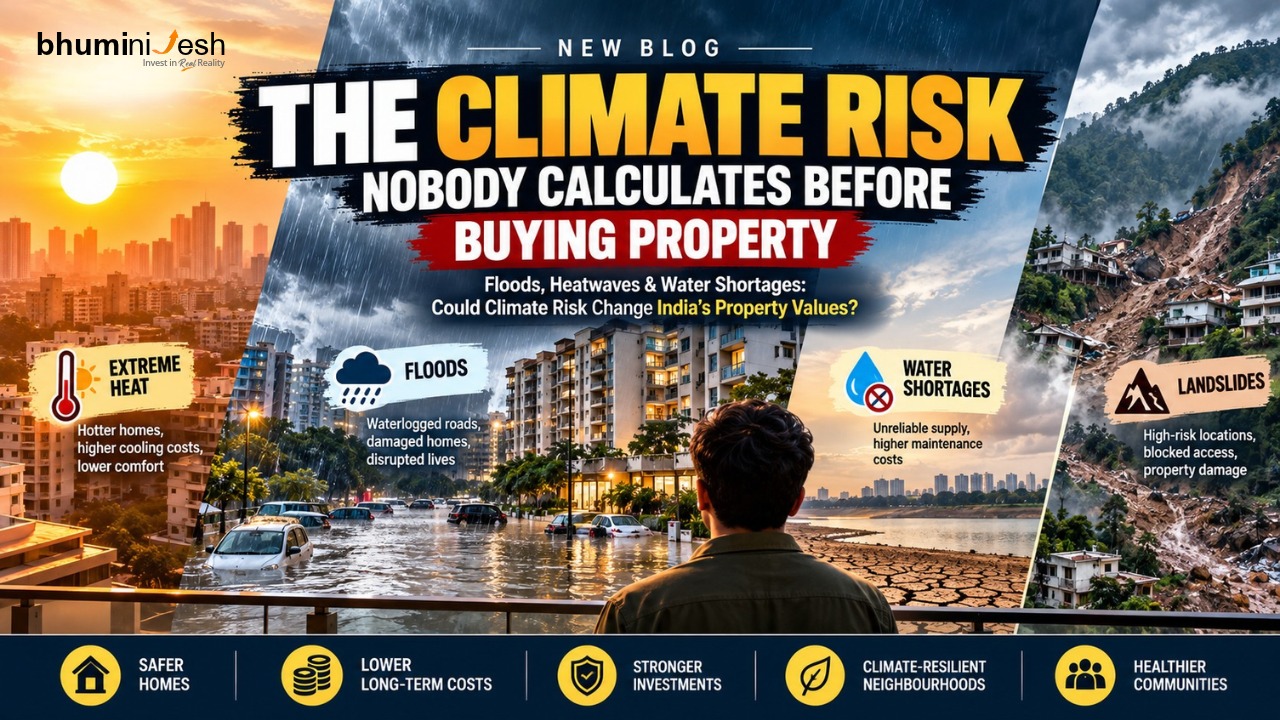
The Climate Risk Nobody Calculates Before Buying Property
Introduction: What If Your Dream Home Is in the Wrong Place?
Imagine buying an apartment with a beautiful view, modern interiors, a gym, a swimming pool and a promising location. The paperwork is in order, the builder has delivered the project, and the property appears to be a sound long-term investment.
Then the problems begin.
During the monsoon, the access road floods. The basement parking fills with water. The lift stops working. A few months later, water supply becomes unreliable, forcing residents to pay for tankers. During summer, the apartment becomes unbearably hot, and electricity bills rise as air-conditioning runs for longer hours.
The building may be relatively new. Its location may still be desirable. Yet the experience of living there—and the cost of owning it—can be very different from what the buyer expected.
This is why climate risk deserves a place in every serious property-buying decision.
Flooding, extreme heat, water stress and landslides are not merely environmental issues. They can affect daily life, building maintenance, access to essential services and the long-term attractiveness of a neighbourhood.
India’s urban population is growing, and cities need enormous amounts of new housing and infrastructure. A 2025 World Bank report estimated that India’s urban population could reach 951 million by 2050 and that more than 144 million additional homes would be needed by 2070. The report also warned that extreme heat and urban flooding could cause significant losses without better planning and adaptation.
The question for property buyers is no longer only, “Can I afford this home?”
It is also: “Will this home remain safe, comfortable, accessible and affordable to maintain as the climate and city around it change?”
1. When Heavy Rain Turns a Neighbourhood into a Disaster Zone
Flooding is one of the most visible ways climate and urban planning intersect with real estate. But heavy rainfall alone does not explain why one neighbourhood experiences severe damage while another remains relatively functional.
The outcome also depends on drainage capacity, ground elevation, the condition of nearby rivers and drains, the amount of paved land, construction on natural drainage routes and the readiness of public infrastructure.
The National Institute of Disaster Management has highlighted how intense rainfall, rapid urbanisation, encroachment on natural drainage systems and inadequate stormwater management can combine to worsen urban flooding. Its training material discusses recurring problems in cities including Mumbai, Chennai, Bengaluru, Delhi, Hyderabad and Ahmedabad.
Recent example: Punjab’s 2025 floods
In August 2025, Punjab experienced a serious flood situation after heavy rainfall and rising water levels in the Ravi and Beas rivers, alongside water releases from the Ranjit Sagar Dam. A Government of India disaster situation report listed 1,247 affected villages across 12 districts, with 261,426 people affected and 16,568 evacuated in the reported period.
For residents, flooding can mean damaged homes, disrupted roads, loss of access to workplaces and schools, contaminated water, damaged electrical equipment and prolonged recovery.
For property owners, the consequences can continue after the visible water disappears. Damp walls, damaged flooring, electrical repairs, basement restoration and disputes over responsibility for common areas may generate unexpected costs.
A property does not need to sit directly beside a river to be exposed. Low-lying roads, poorly drained sectors, blocked stormwater channels and basement entrances can create localised vulnerabilities.
What buyers should learn: Investigate how the entire neighbourhood drains—not just whether the building itself looks elevated.
Useful starting point: National Institute of Disaster Management — urban flooding training material.
2. The Himalayan Warning: When Hillside Property Becomes High Risk
Hillside homes, mountain-view apartments and holiday properties can be appealing investments. But mountain terrain brings hazards that buyers in flatter cities may underestimate.
Heavy rainfall can saturate soil and destabilise slopes. Landslides can block roads, damage buildings and isolate communities. Flash floods may arrive rapidly through narrow valleys, while construction, slope cutting and inadequate drainage can worsen local exposure.
Recent example: Jammu and Kashmir in 2025
The Government of India’s disaster reporting recorded multiple incidents in Jammu and Kashmir during August 2025, including a cloudburst in Kishtwar, flash flooding in Doda, landslides in Reasi and Kathua, and flooding in Jammu district.
The same report’s cumulative figures for the reported incidents listed 136 deaths, 35 people missing, 151 injured and 3,677 damaged houses—1,180 fully damaged and 2,497 partially damaged. These figures relate to the report’s specified incidents and reporting period, not to every disaster in the region that year.
The significance for property buyers is not that all mountain properties are unsafe. It is that a scenic view is not evidence of a safe site.
Before buying a hillside property, investigate the slope, retaining structures, drainage arrangements, geological assessments where available, road access and any official hazard warnings. Be particularly cautious where a plot requires substantial cutting or filling of a hillside.
A property can remain physically intact while the access road or surrounding slope becomes unsafe. That can still make it difficult to occupy, rent or sell.
3. Extreme Heat: The Hidden Cost of Living in a Hotter City
Flooding damages property visibly. Heat often creates a slower, less obvious burden.
During hot weather, poorly shaded apartments can become uncomfortable, particularly when windows face intense afternoon sun, roofs absorb heat, ventilation is inadequate and surrounding streets have little tree cover. Residents may need more air-conditioning, raising electricity consumption and operating costs.
The World Bank’s 2025 report on Indian cities noted that urban heat-island effects can make city centres more than 3–4°C hotter than surrounding areas. It also warned that dense development and the loss of surfaces that absorb rainwater can increase vulnerability to flooding.
Recent example: Gurugram’s heat and flooding
Gurugram illustrates how different weather hazards can affect the same urban area. An Indian Express explainer published in 2026 reported that temperatures in parts of Gurugram crossed 44°C in May, followed by heavy rain that inundated major roads and low-lying sectors on 6 August. The article linked the impacts to factors including dense construction, inadequate drainage, loss of open land and public systems that were not sufficiently prepared.
For residents, extreme heat can mean higher cooling bills, uncomfortable indoor conditions and greater health risks. For building owners, it can highlight weaknesses in insulation, shading, ventilation and energy systems.
When comparing apartments, look beyond the number of air-conditioners or the presence of a clubhouse. Consider the building’s orientation, shading, roof design, cross-ventilation, tree cover and the heat absorbed by surrounding roads and parking areas.
A climate-conscious home is not simply one with more cooling equipment. It is one designed to reduce the amount of cooling required in the first place.
4. Water Scarcity: Can a Home Be Valuable If Water Is Unreliable?
Water availability is another major consideration in property investment. A modern apartment can have attractive interiors and extensive amenities, but residents still depend on a reliable water supply for drinking, cooking, cleaning and sanitation.
When municipal supply becomes unreliable, some societies rely on tankers, borewells or a combination of sources. This may keep a building functioning, but it can increase costs and create uncertainty.
Groundwater depletion is especially relevant in fast-growing urban and peri-urban areas. When demand rises faster than sustainable supply, residents, businesses and developers may compete for a limited resource.
A 2025 World Bank report on urban resilience identified extreme weather and infrastructure vulnerability as major challenges for Indian cities. Water security should therefore be examined alongside drainage, heat exposure and access to public services—not treated as a minor utility detail.
Why this matters for property value
Water stress can affect the cost of maintaining a property, the quality of daily life and the attractiveness of a location to potential tenants. However, it does not follow that every water-stressed neighbourhood will experience a price decline. Prices also depend on employment, transport, supply, local regulations and the ability of authorities or developers to improve water systems.
Before purchasing, ask:
- What is the property’s primary water source?
- Is the municipal connection operational and reliable?
- Does the society depend heavily on tankers?
- Are borewells used, and are they legally permitted?
- Is rainwater harvesting installed and maintained?
- Are water bills, tanker expenses or supply interruptions documented in society records?
For a large residential project, also examine how water is managed during summer peaks and whether the advertised arrangements are already operational or merely planned.
A swimming pool is an amenity. Reliable water for residents is a necessity.
5. Climate Risk Is Also a Building and Neighbourhood Design Problem
It is tempting to think of climate disasters as events that arrive from outside the city. In reality, the design of buildings and neighbourhoods can influence how severely hazards affect residents.
A heavy downpour is more dangerous where stormwater drains are undersized or blocked. A heatwave is harder to endure where streets have no shade and homes trap heat. A water shortage is more disruptive where buildings depend on a single vulnerable source and have no efficient water-management systems.
The World Bank’s 2025 report, Towards Resilient and Prosperous Cities in India, argues that better planning and investment in resilient urban infrastructure can reduce losses from heat and flooding. Its analysis of 24 cities emphasises the importance of adapting urban development rather than allowing growth to increase exposure.
For homebuyers, this means evaluating both the property and its surroundings.
Look for functioning stormwater drains, maintained public roads, safe access routes, shade and tree cover, reliable utilities, water-management systems and a neighbourhood that can continue operating during severe weather.
Also investigate the site’s history. Ask existing residents whether the basement floods, whether the approach road becomes impassable, whether water tankers are routinely needed and whether the society has experienced major weather-related repairs.
Residents’ experiences can reveal problems that brochures and site visits during dry weather may not show.
6. Could Climate Risk Affect Property Prices and Rental Demand?
Climate exposure can influence property economics through several channels:
- Repair and maintenance: Flood damage, moisture, corrosion and heat-related equipment stress may increase expenses.
- Occupancy and rental demand: Residents may prefer homes with more reliable access, water and indoor comfort.
- Operating costs: Cooling, water supply and building maintenance can affect the total cost of living.
- Financing and insurance: Depending on the property, lender requirements, policy exclusions, deductibles and insurance availability may affect the cost or feasibility of ownership.
- Resale confidence: Buyers who discover repeated flooding or water shortages may negotiate more aggressively or avoid a property.
A 2026 study published in Discover Cities examined how climate risks are understood and incorporated into India’s urban real estate market. It highlighted gaps in risk disclosure and investment decision-making, alongside concerns about flood-exposed and water-stressed locations. This is a research synthesis, not proof that every exposed property has already lost value.
It is important to avoid one simplistic conclusion: climate risk always means falling prices.
A desirable location may remain in demand despite exposure. Some risks can be reduced through drainage improvements, resilient design, better water management or public infrastructure investment. Other risks may be difficult or uneconomic to address.
The sensible investment approach is to assess the hazard, the property’s vulnerability, the cost of mitigation and the residual risk that remains.
A lower purchase price does not necessarily make an exposed property a bargain. The discount may be smaller than the future cost of repairs, disruption or adaptation.
7. A Climate-Risk Checklist Before You Buy
Use this checklist before paying a booking amount or signing a sale agreement.
1. Check the flood history. Ask residents, the housing society and local authorities about previous waterlogging, basement flooding, blocked roads and drainage failures.
2. Examine the elevation and drainage. Understand the plot’s relative height, nearby drains, low-lying roads and whether stormwater has a clear route away from the property.
3. Investigate heat exposure. Check orientation, roof exposure, shading, ventilation, tree cover and the amount of hard paving around the building.
4. Verify water security. Confirm the actual supply sources, seasonal reliability, tanker dependence, water charges and functioning rainwater-harvesting systems.
5. Review the building’s resilience. Ask about waterproofing, basement protection, electrical equipment placement, backup power, fire safety and maintenance records.
6. Investigate local hazards. Depending on the location, check official flood maps, landslide susceptibility information, coastal or erosion hazards, and relevant disaster-management advisories.
7. Read the insurance terms. If insurance is available and appropriate, verify what is covered, what is excluded, applicable deductibles and whether building structure and household contents require separate policies. Do not assume every climate-related loss is insured.
8. Ask about the approach road. A building may be safe internally but difficult to reach when surrounding roads flood or slopes fail.
9. Compare total ownership costs. Include maintenance, cooling, water, possible repairs and reasonable contingency—not just the EMI and purchase price.
10. Verify claims independently. A developer’s statement that a project is “flood-proof,” “green” or “climate-resilient” should be supported by appropriate technical evidence, approvals and operational records.
No checklist can eliminate every risk. But these checks can help buyers identify avoidable surprises before committing a large share of their savings.
8. What Developers and Homebuyers Should Do Differently
Climate resilience should not be treated as a premium feature reserved for luxury housing. It should be part of basic planning for homes at every price point.
Developers can improve resilience by assessing site-specific hazards before construction, protecting natural drainage routes, designing suitable stormwater systems, using effective roof and wall insulation, planning shade and landscaping, and providing practical water-management systems.
Housing societies can maintain drains, inspect waterproofing, prepare emergency plans, manage water consumption and maintain records of past incidents and repairs.
Municipal authorities also have an essential role. Individual property owners cannot solve citywide drainage failures, restore every lost water body or prevent all landslides. Resilient buildings need resilient neighbourhoods, infrastructure and public services.
The Government of India’s National Disaster Management Authority provides disaster preparedness information, while the India Meteorological Department publishes weather forecasts and warnings. Buyers in vulnerable locations can use these resources alongside local planning documents, site inspections and professional assessments.
9. India’s Climate-Resilient Real Estate Opportunity
Climate risk creates challenges, but it also presents an opportunity to improve how India builds and maintains its cities.
The country still needs substantial housing, transport, drainage, water and energy infrastructure. The World Bank’s 2025 urban-resilience report argues that better adaptation can reduce future losses from flooding and extreme heat. It estimated that adaptation measures could avert substantial annual flood-related losses and help prevent heat-related deaths. These are modelled estimates, not guaranteed outcomes.
For real estate, the opportunity lies in practical solutions: buildings that stay cooler with less energy, neighbourhoods that manage rainwater better, reliable water systems, stronger maintenance practices and more informed land-use decisions.
Investors may increasingly benefit from assessing these features as part of a property’s long-term quality. But resilience claims should be evaluated carefully. A few solar panels or a landscaped entrance do not establish that a development can withstand flooding, extreme heat or water shortages.
The real test is whether the property has been designed for its location, whether its systems function in practice, and whether the owner or society can maintain them over time.
Conclusion: Buy the Home, but Investigate the Future Around It
A property’s purchase price tells only part of its story. The cost of living there, maintaining it and protecting it from foreseeable hazards can matter just as much over the years.
Recent floods in Punjab and Jammu and Kashmir, alongside the combination of extreme heat and urban flooding seen in Gurugram, demonstrate how weather hazards can disrupt residents and damage homes and infrastructure. These events have different causes and local circumstances, but they share an important lesson: the impact of a disaster depends not only on the hazard, but also on where and how people build and live.
For homebuyers, that means investigating flood history, water supply, heat exposure, drainage and building maintenance before purchasing. For investors, it means looking beyond today’s rent or resale price and considering whether the property can remain attractive and functional over the long term.
A climate-resilient property is not one that can never be affected by extreme weather. It is one whose risks have been understood, whose vulnerabilities have been addressed where practical, and whose remaining risks are acceptable to the buyer.
Before you buy your next property, ask not only whether you love the home—but whether the location and building are prepared for the future you are buying into.
Frequently asked questions
1. Can climate change affect property prices in India?
It can influence property desirability and ownership costs through flooding, heat, water shortages, infrastructure disruption and repair expenses. The effect on prices varies by location and the property’s ability to withstand or adapt to those risks.
2. How do I check whether a property is in a flood-prone area?
Review local flood-risk information where available, consult relevant municipal and disaster-management authorities, inspect the site’s elevation and drainage, and ask residents about previous flooding. A single site visit during dry weather is not sufficient.
3. Are high-rise apartments safer during floods?
Not necessarily. Upper-floor homes may avoid some direct floodwater exposure, but basements, electrical systems, lifts, access roads, water supply and emergency access can still be affected. Safety depends on the entire development and its surroundings.
4. Why is water availability important when buying a home?
Unreliable water can disrupt daily life and increase household or society expenses through tanker purchases, storage and maintenance. Buyers should confirm the property’s actual water sources and seasonal reliability.
5. What makes a property climate-resilient?
Relevant features can include effective drainage, suitable site selection, heat-conscious design, reliable water management, protected electrical systems, appropriate landscaping and strong maintenance practices. The right measures depend on local hazards.
6. Should I avoid every property in a climate-exposed location?
Not automatically. Assess the severity of the risk, whether mitigation is feasible, the cost of ownership and the consequences if the hazard occurs. Some risks are manageable; others may make a property unsuitable for your needs or financial situation.
Sources and further reading
1. World Bank — Towards Resilient and Prosperous Cities in India — urban heat, flood risk and resilient infrastructure.
2. Government of India — Disaster situation report on Jammu and Kashmir and Punjab — reported impacts from 2025 incidents.
3. The Indian Express — Why Indian cities flood and overheat — urban planning, heat and drainage issues, including Gurugram.
4. National Institute of Disaster Management — Urban flooding training report — urban flood mechanisms and examples from Indian cities.
5. Discover Cities — Climate Risk and Stranded Asset Vulnerability in India’s Urban Real Estate Market — research on climate-risk awareness, disclosure and real estate exposure.
6. India Meteorological Department — weather forecasts and official warnings.
7. National Disaster Management Authority — disaster preparedness and risk-reduction resources.
Editorial disclaimer: This article is for general information and investment education, not a property valuation or site-specific hazard assessment. Weather risks vary locally. Verify current official information and obtain qualified engineering, legal or insurance advice where appropriate.
