
The Water Effect: Why Water May Become the Next Big Driver of Real Estate Prices in India
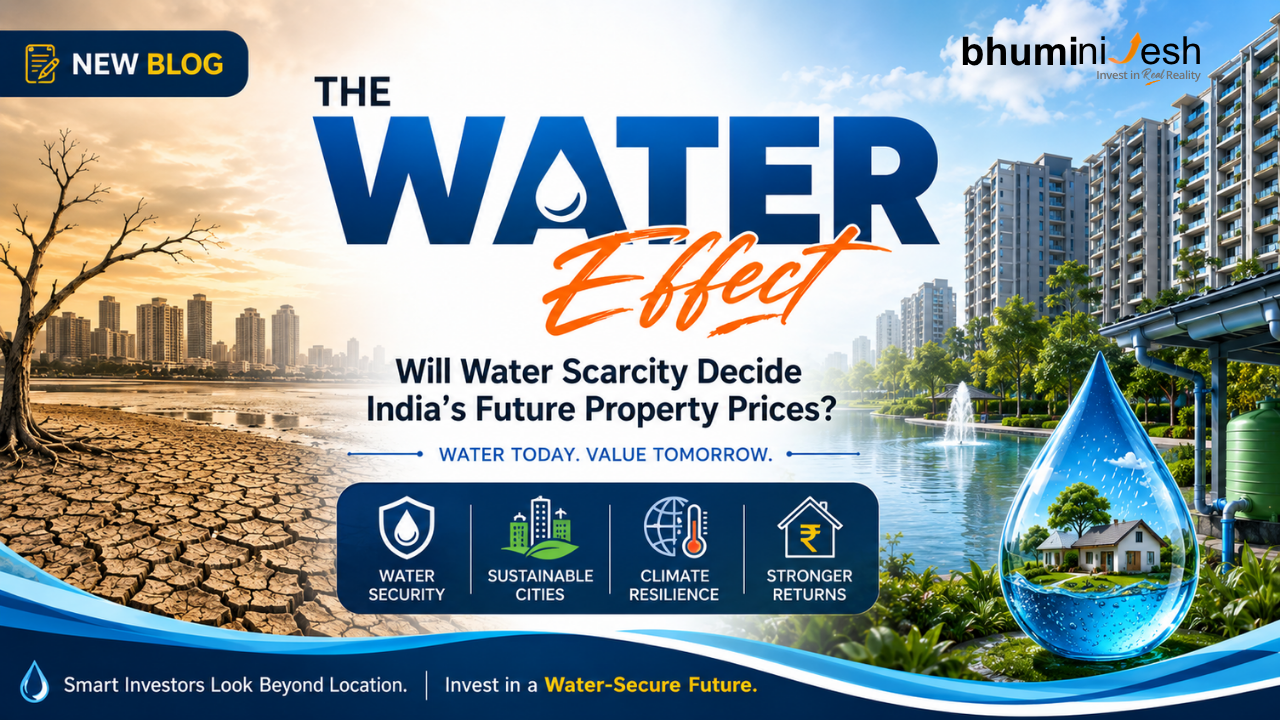
For decades, property buyers and investors have followed one golden rule—Location, Location, Location. A home close to metro stations, highways, business districts, airports, or reputed schools has traditionally commanded higher prices and better appreciation. However, a silent transformation is taking place across India that could redefine how real estate is valued over the next two decades.
That transformation is water security.
Imagine purchasing a premium apartment in a rapidly growing city, only to discover that every summer your housing society spends lakhs of rupees on private water tankers because groundwater levels have fallen dramatically. Now imagine another township that has reliable municipal water, rainwater harvesting, recycled wastewater, and sustainable groundwater recharge. Which property is more likely to appreciate over the next twenty years?
Increasingly, the answer lies not just in location—but in water availability.
Water scarcity is no longer only an environmental issue. It is becoming an economic challenge, an urban planning concern, and most importantly, a real estate investment factor. As India’s population grows, climate change alters rainfall patterns, and cities expand rapidly, reliable access to water is emerging as one of the strongest indicators of long-term property demand.
India’s Water Challenge: A Reality Investors Cannot Ignore
India is home to nearly 18% of the world’s population but possesses only about 4% of the world’s freshwater resources, making efficient water management one of the country’s biggest development priorities. According to the NITI Aayog Composite Water Management Index (CWMI), many regions face increasing groundwater depletion, while water demand continues to rise due to urbanisation, agriculture, and industrial growth.
The Central Ground Water Board (CGWB) has also reported declining groundwater levels in several urban regions because of excessive extraction. Meanwhile, the Ministry of Jal Shakti continues to promote rainwater harvesting, groundwater recharge, and integrated water resource management to improve long-term sustainability.
For real estate, this means one thing: cities that manage water efficiently are likely to remain attractive for investment, while those struggling with water shortages may face increasing operational costs and slower property appreciation.
Why Water Matters to Property Prices
Water affects almost every aspect of real estate.
When water becomes scarce:
- Housing societies rely on expensive private tankers.
- Monthly maintenance charges increase.
- Commercial establishments incur higher operating costs.
- Businesses reconsider expansion plans.
- Homebuyers begin preferring areas with reliable water infrastructure.
Developers also spend more on:
- Borewells
- Storage tanks
- Sewage Treatment Plants (STPs)
- Rainwater harvesting systems
- Smart water monitoring
- Recycling infrastructure
These investments eventually influence project costs and selling prices.
Unlike roads or metro stations that can be constructed over a few years, reservoirs, river-linking projects, desalination plants, and groundwater recharge programmes often require long-term planning and significant investment. This makes water infrastructure one of the most valuable hidden assets for future cities.
Bengaluru: A Wake-Up Call for Urban India

Bengaluru is one of India’s leading technology hubs, attracting multinational companies, startups, and skilled professionals from across the country. However, rapid urban expansion has placed enormous pressure on its water resources.
During the summer of 2024, many neighbourhoods experienced severe shortages, forcing apartment complexes to depend heavily on private water tankers. Reports from the Bangalore Water Supply and Sewerage Board (BWSSB) highlighted the urgent need for groundwater conservation, water recycling, and stricter management of borewell extraction.
This crisis demonstrated that even premium residential projects are not immune to water stress.
Today, many developers in Bengaluru prominently advertise features such as:
- Rainwater harvesting
- Water recycling systems
- Sewage treatment plants
- Smart water meters
- Dual plumbing systems
These are no longer viewed simply as environmental initiatives—they have become premium selling points.
Chennai: A Story of Recovery Through Planning
Chennai experienced one of India’s most severe urban water crises in 2019, when reservoirs ran critically low and residents depended heavily on tanker water. The crisis highlighted the risks of inadequate water planning in rapidly expanding cities.
Since then, authorities have invested in desalination plants, reservoir restoration, groundwater recharge, and rainwater harvesting initiatives. These long-term measures have significantly improved the city’s resilience.
The lesson for investors is clear:
Water scarcity does not automatically reduce property values. Poor water management does.
Cities that proactively invest in sustainable water infrastructure are likely to retain long-term investor confidence.
The Rise of Water-Smart Townships
Modern developers increasingly recognise that buyers are looking beyond luxury amenities.
Today’s successful residential projects incorporate:
- Rainwater harvesting
- Sewage Treatment Plants (STPs)
- Water recycling systems
- Smart leak detection
- Low-flow plumbing fixtures
- Native landscaping requiring less irrigation
These features reduce dependence on external water sources while lowering maintenance costs for residents.
As sustainability becomes more important, water-efficient communities are expected to command higher buyer preference.
Climate Change Is Changing Real Estate
Climate scientists have repeatedly warned that rainfall patterns are becoming more unpredictable. Some regions experience prolonged droughts, while others face intense rainfall and flooding.
These changes influence long-term property demand.
Cities investing in:
- Reservoir expansion
- Smart water grids
- Desalination
- Lake restoration
- River rejuvenation
- Wastewater recycling
are likely to remain more resilient than those relying primarily on groundwater.
For investors, climate resilience is becoming another important criterion alongside connectivity and employment opportunities.
What Smart Homebuyers Should Ask
Before purchasing a property, buyers should ask more than just the selling price.
Important questions include:
- What is the primary water source?
- Does the project have rainwater harvesting?
- Is wastewater recycled?
- How often are water tankers required?
- Are groundwater levels stable?
- Does the society have an operational Sewage Treatment Plant?
- What are the average monthly water charges?
These questions provide valuable insight into the long-term sustainability of the property.
Investment Opportunities
Water scarcity is creating new investment opportunities.
Projects likely to benefit include:
- Sustainable townships
- Green-certified residential communities
- Smart cities
- Industrial parks with assured water supply
- Commercial developments using recycled water
- Integrated townships designed around water conservation
Institutional investors increasingly evaluate environmental sustainability before investing in large developments.
The Future of Indian Real Estate
Over the next two decades, Indian real estate will be shaped by several transformative trends:
- Artificial Intelligence
- Data Centres
- Airports
- Expressways
- Semiconductor Parks
- Renewable Energy
- Smart Cities
- Climate Resilience
- Water Security
Among these, water security is perhaps the least discussed—but potentially one of the most important.
The cities that successfully manage water resources are likely to attract industries, businesses, professionals, and long-term investment. Those that fail may experience rising costs and slower property growth.
Conclusion: Water Is Becoming the New Location
For generations, property buyers focused primarily on connectivity and convenience. Tomorrow’s buyers may ask an equally important question:
“Will this property have reliable water twenty years from now?”
Water is no longer just a utility. It is becoming a strategic infrastructure asset that directly influences quality of life, operational costs, and investment potential.
Just as metro corridors, airports, and expressways transformed property markets in the past, sustainable water infrastructure may become the next major driver of real estate appreciation.
The smartest investors of tomorrow will not only study master plans and infrastructure announcements. They will also examine reservoirs, groundwater reports, rainwater harvesting policies, and climate resilience.
Because in the coming decades, water may become the invisible force that separates ordinary investments from extraordinary ones.
